YouTube Shorts is now the fastest-growing content format on the platform. But how much does it actually pay? The honest answer: less than you expect from ads alone, but far more valuable as a growth engine than most creators realize.
This guide breaks down the exact numbers - per 1,000 views, per 1 million views, by niche, and with music. No guesswork, no inflated estimates.
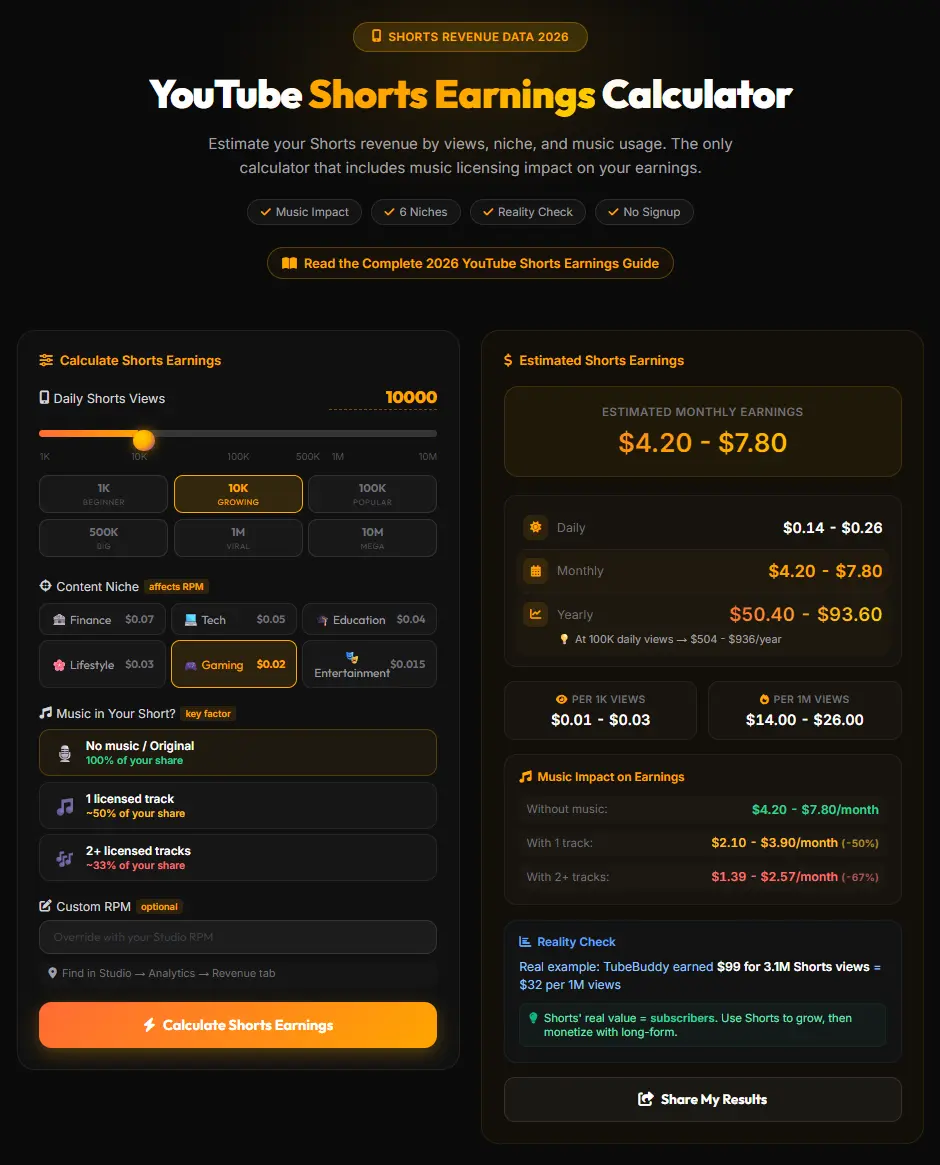
Get instant estimates: Use the YouTube Shorts Earnings Calculator to see your projected daily, monthly, and yearly revenue based on your views, niche, and music usage.
How Much Does YouTube Shorts Pay Per 1,000 Views?
YouTube Shorts pays between $0.01 and $0.10 per 1,000 views on average. The exact amount depends heavily on your niche and where your audience is located (US/UK/Canada = highest rates).
| Niche | Per 1K Views | Per 1M Views | Monthly (10K views/day) |
|---|---|---|---|
| Finance | $0.07 | $70 | $21/mo |
| Tech | $0.05 | $50 | $15/mo |
| Education | $0.04 | $40 | $12/mo |
| Lifestyle | $0.03 | $30 | $9/mo |
| Gaming | $0.02 | $20 | $6/mo |
| Entertainment | $0.015 | $15 | $4.50/mo |
Finance pays 4-5x more than Entertainment because financial advertisers (brokerages, fintech apps, credit cards) have extremely high customer lifetime values and bid aggressively for attention. Entertainment content attracts brand awareness campaigns with low-cost CPMs.
Geography multiplier: A million views from the US can earn $50-$100. The same million views from India or Brazil often earns just $5-$15. Audience location is the most powerful variable you cannot directly control.
How YouTube Shorts Revenue Actually Works
Shorts does not use the traditional CPM model where ads are attached directly to your video. Instead, YouTube uses a shared pool system with 3 steps:
Step 1: All Shorts ad revenue goes into a national pool
YouTube collects all ad revenue generated between Shorts videos in a given country each month. YouTube Premium revenue from users watching Shorts is also added proportionally. This creates one large country-specific fund.
Step 2: Music rights holders take their cut first
Before any creator receives a cent, every music label and publisher with rights to songs used across all Shorts in that pool extracts its licensing fees. This is calculated proportionally based on how many Shorts used licensed tracks.
Step 3: You receive 45% of your proportional share
After music rights holders are paid, the remaining pool is divided among all eligible creators based on their share of total Shorts views that month. YouTube keeps 55% and pays creators 45% - the inverse of long-form video (where creators get 55%).
Your monthly payout = (Your views / Total pool views) x (Pool after music cuts) x 45%
Does YouTube Shorts Pay Less Than Regular Videos?
Yes - significantly less per view. Here is a direct comparison:
| Shorts | Long-Form Video | |
|---|---|---|
| Revenue Model | Pool-based | Direct CPM/RPM |
| Creator Share | 45% | 55% |
| Average RPM | $0.03 - $0.10 | $1 - $10 |
| Per 1M views | $30 - $100 | $1,000 - $10,000 |
| Music Impact | -50% per track | None |
| Best Use For | Channel growth | Ad revenue |
Long-form video pays 10x to 100x more per view because ads are inserted directly into your video with a fixed, predictable CPM. To understand your RPM across all your content formats, compare both numbers in your YouTube Analytics.
The takeaway: Shorts are not a replacement for long-form revenue. They are the most efficient growth mechanism for building the subscriber base that watches your monetized long-form content.
Real Numbers: How Much YouTube Paid for 1 Million Shorts Views
Theory aside, here is what real creators and verified sources reported earning:
| Creator / Source | Total Views | Total Earned | Per 1M Views |
|---|---|---|---|
| TubeBuddy (case study) | 3.1M | $99 | $32 |
| Zach King | 10M | $91 | $9 |
| JennyHoyos | 22M | $1,200 | $54 |
The range from $9 to $54 per million views reflects the niche and audience geography differences. JennyHoyos targets English-speaking lifestyle audiences with strong US viewership. Zach King’s viral comedy content attracts a globally distributed audience skewed toward lower-CPM markets.
Most creators with mixed global audiences report $20-$40 per million Shorts views as a realistic benchmark.
Does Music Reduce Your YouTube Shorts Earnings?
This is the most overlooked variable in Shorts monetization - and the most financially damaging.
When you use a licensed music track (any song from YouTube’s library with a rights holder), that rights holder receives a portion of the pool revenue attributed to Shorts using their track. This comes directly out of your creator share before YouTube takes its cut.
Music licensing impact on earnings:
| Audio Used | Your Share of Pool | Effect |
|---|---|---|
| Original audio / no music | 100% | Full payout |
| 1 licensed track | ~50% | Half your earnings gone |
| 2+ licensed tracks | ~33% | Two-thirds lost |
Practical example - Finance niche, 10,000 daily views:
- No music: $21/month
- 1 licensed track: $10.50/month (losing $10.50)
- 2+ licensed tracks: $6.93/month (losing $14.07)
Over 12 months, that single music track costs you $126 in lost earnings. For creators posting daily Shorts, using original voiceovers, trending sounds marked “royalty-free”, or YouTube Audio Library tracks with no revenue sharing attached is the highest-impact financial decision you can make.
YouTube Shorts Monetization Requirements (2026)
To receive any ad revenue from Shorts, you must be accepted into the YouTube Partner Program (YPP). Here are the requirements:
You need:
- 1,000 subscribers
Plus either:
- 10 million public Shorts views in the last 90 days
- OR 4,000 valid public watch hours on long-form videos in the last 12 months
Once accepted into YPP, Shorts monetization is automatic - you do not need to apply separately. You can check your monetization eligibility at any time to see how close you are to the thresholds.
Important: Non-public Shorts (private, unlisted, or age-restricted) do not count toward the 10M view threshold.
How Many Views Do You Need to Make Money on YouTube Shorts?
Using average RPM figures, here are the daily view volumes needed to hit income targets purely from Shorts ad revenue:
| Monthly Target | Daily Views Needed (Average) | Daily Views (Finance Niche) |
|---|---|---|
| $10/month | 50,000 - 100,000 | ~14,000 |
| $100/month | 500,000 - 1M | ~143,000 |
| $1,000/month | 5M - 10M | ~1.4M |
| $10,000/month | 50M - 100M | ~14M |
These numbers explain why the most profitable Shorts creators do not rely on ad revenue alone. At 10,000 daily views - a solid mid-tier channel - you earn less than $10/month from Shorts ads. The real revenue comes from the strategies below.
How to Make More Money From YouTube Shorts (Beyond Ads)
The top-earning Shorts creators make 80-90% of their income from sources other than the ad revenue pool.
1. Brand deals and sponsorships
Brands pay $500 to $50,000+ per sponsored Short depending on niche and channel size. At 100,000 subscribers in Finance or Tech, a single sponsored Short can earn more than an entire year of Shorts ad revenue from the same views.
2. Drive traffic to long-form videos
A Short that gets 1 million views and converts 1% of viewers to watch a full 15-minute video has just delivered 10,000 long-form views. Those 10,000 views at a $5 RPM = $50 from one piece of long-form content. Calculate your long-form earnings to see the full revenue picture.
3. Affiliate marketing
Shorts with direct, problem-solving content (tutorials, reviews, quick tips) convert well for affiliate links placed in the video description. Finance, Tech, and Software niches generate the highest affiliate commissions per click.
4. Merchandise and digital products
Shorts build personal brand recognition faster than almost any other format. A creator with 1 million subscribers from Shorts can launch a course, ebook, or merch line and earn 10x their annual Shorts ad revenue from a single launch.
5. Channel memberships
The YouTube Shorts algorithm aggressively promotes content to non-subscribers. When viewers subscribe through Shorts, converting even 1% to channel members at $4.99/month creates a predictable, algorithm-independent income stream.
Build your strategy: Add captions to your Shorts to increase discoverability, then use the YouTube Shorts Earnings Calculator to model different growth scenarios.
Frequently Asked Questions
How much does YouTube Shorts pay for 1 million views? YouTube Shorts pays approximately $25 to $100 for 1 million views, depending on your niche and audience geography. Finance Shorts earn around $70 per million views. Entertainment and Gaming Shorts earn $10 to $20 per million. Using licensed music reduces these figures by approximately 50% per track used.
Does YouTube pay for every Shorts view? No. Only views that occur after you are accepted into the YouTube Partner Program (YPP) are eligible for revenue sharing. Views from non-public Shorts, views from your own account, and views generated before joining YPP do not generate ad revenue. Additionally, the payment is pool-based, not a fixed amount per view.
How much does YouTube Shorts pay per 1,000 views? YouTube Shorts pays between $0.01 and $0.10 per 1,000 views on average. Finance content earns approximately $0.07 per 1,000 views. Entertainment content earns approximately $0.015 per 1,000 views. These are average figures - actual payouts vary month to month based on total advertiser spend in the Shorts pool.
Is YouTube Shorts profitable in 2026? As a direct ad revenue source, Shorts is not highly profitable - $30 to $100 per million views requires enormous volume to generate meaningful income. As a growth channel that drives subscribers to long-form content, brand deals, and affiliate revenue, Shorts is exceptionally profitable. The most successful strategy combines Shorts for audience growth with long-form video for revenue generation.
Can I make money on YouTube Shorts without 1,000 subscribers? No. YouTube Partner Program membership is required to receive Shorts ad revenue, and YPP requires a minimum of 1,000 subscribers plus either 10 million Shorts views in 90 days or 4,000 long-form watch hours. Without meeting these thresholds, your Shorts views generate zero direct ad revenue.
Does using music reduce my Shorts earnings? Yes, significantly. Using one licensed track reduces your creator share by approximately 50%. Using two or more licensed tracks reduces it to approximately 33% of your base earnings. Over a full year, this music tax can cost creators hundreds or thousands of dollars. Using original audio, voiceovers, or royalty-free tracks with no revenue sharing eliminates this loss entirely.
How much do YouTube Shorts pay per view compared to long-form? Shorts pay approximately $0.00003 to $0.0001 per individual view. Long-form videos pay approximately $0.001 to $0.01 per view. Long-form earns roughly 10x to 100x more per view because it uses direct CPM advertising rather than the shared pool model and because creators retain 55% rather than 45% of revenue.
Your YouTube Shorts Revenue Toolkit
- YouTube Shorts Earnings Calculator - Estimate your earnings by views, niche, and music usage
- YouTube RPM Calculator - Understand your combined RPM across Shorts and long-form
- YouTube Money Calculator - Calculate your long-form video earnings potential
- YouTube Monetization Checker - Check if a channel meets YPP requirements
- YouTube Shorts Caption Extractor - Add captions to boost Shorts discoverability
Shorts ad revenue alone will not make you a full-time creator. But Shorts that grow your channel, feed your long-form funnel, and build your brand absolutely will. Calculate your earnings now and build your 2026 Shorts strategy around real numbers.
![YouTube Channel Comparison: Evaluate Any Two Creators for Free [2026]](/images/seo/youtube-channel-comparison/youtube-channel-comparison.webp)