YouTube Keyword Research: How to Find the Best Keywords for Your Videos [2026]
In the rapidly evolving landscape of digital media and platform algorithms, YouTube keyword research has transcended the simplistic practice of identifying high-volume search terms. By 2026, it has become a sophisticated discipline defined as semantic intent modeling - the precise alignment of viewer psychology, predictive search algorithms, and artificial intelligence retrieval systems. At its core, YouTube keyword research is the strategic methodology used to determine exactly what the target demographic is querying, the underlying intent behind that query, and how the platform’s neural networks categorize and surface content to satisfy that specific demand.
The critical distinction that defines video optimization in 2026 is that YouTube is not merely a traditional index of text; it is the world’s second-largest search engine operating predominantly on experiential and visual intent. When individuals enter a query into a traditional text-based search engine, they are frequently seeking a swift, textual answer or a transactional destination. Conversely, when the exact same query is inputted into YouTube, the intent fundamentally shifts toward observational learning, parasocial engagement, immersive tutorials, or entertainment. Therefore, keyword research on this platform requires a nuanced understanding of how human behavioral patterns translate into sustained watch time.
The macroeconomic importance of exhaustive keyword research is heavily underscored by the systemic shifts in global search visibility. With the maturation of AI-generated summaries - such as Google’s Search Generative Experience (SGE) and autonomous answer engines like Perplexity, Gemini, or ChatGPT - the digital ecosystem has entered a definitive “zero-click” era. In 2026, empirical data indicates that AI Overviews dominate over 86.8% of commercial search queries, meaning that traditional textual website traffic in highly competitive sectors has plummeted by as much as 64%, with zero-click rates reaching up to 99% for specific commercial niches.
However, these same AI interfaces actively pull, cite, and embed YouTube videos as primary source material to answer complex user prompts. Consequently, executing rigorous YouTube keyword research ensures that video content is not only discoverable within the native YouTube application itself but is also heavily indexed and recommended by global AI search interfaces, effectively bypassing the zero-click penalty that devastates standard textual content.
Furthermore, keyword research acts as the architectural foundation of a channel’s long-term sustainability and commercial viability. Without a data-driven keyword strategy, content creators fall victim to the “post and pray” methodology, relying entirely on erratic, social-driven spikes in traffic that typically evaporate within 48 hours of publication. Organic search traffic, powered by carefully selected evergreen keywords, operates on a fundamentally different paradigm. Videos optimized for specific, data-backed queries accumulate compounding views over months and years, remaining immune to the immediate decay of algorithm feed cycles.
The financial implications of this compounding traffic are substantial. Strategic keyword mapping allows analysts to target high-intent sectors where advertisers are willing to pay premium rates. For example, keywords targeting the software and technology niche command Revenue Per Mille (RPM) rates between $12 and $25, while finance and investment keywords range from $10 to $20. By understanding which keywords trigger high-value advertiser bidding and match viewer intent, channels can exponentially increase their monetization efficiency without requiring millions of subscribers.
Ultimately, keyword research in 2026 is the definitive mechanism that separates reactive content production from proactive audience acquisition. Start building your keyword strategy now with our free YouTube Keyword Tool.
How YouTube’s Algorithm Uses Keywords to Rank Videos
To weaponize keyword research effectively, a practitioner must understand the mechanical integration of metadata into YouTube’s 2026 ranking algorithms. Historically, YouTube operated on a relatively linear, text-based search matching paradigm: if a specific term was densely packed into a title, description, and backend tags, the video was highly likely to rank for that term. In 2026, the algorithm operates as a highly complex, multi-layered prediction engine. It utilizes keywords to establish initial semantic context, but it relies almost entirely on hyper-personalized user satisfaction metrics to determine the ultimate ranking velocity and sustained visibility of the content.
When a video file is uploaded, YouTube’s natural language processing (NLP) models ingest all available textual metadata - titles, descriptions, channel tags, and on-screen text overlays - as well as the auditory data extracted via speech recognition. The algorithm utilizes these extracted keywords to create a “Context Anchor”, mapping the video to specific topical clusters within its massive database and establishing its preliminary relevance to historical user queries. However, this keyword matching simply dictates where the video is eligible to appear; it does not dictate how high it will rank or how often it will be suggested.
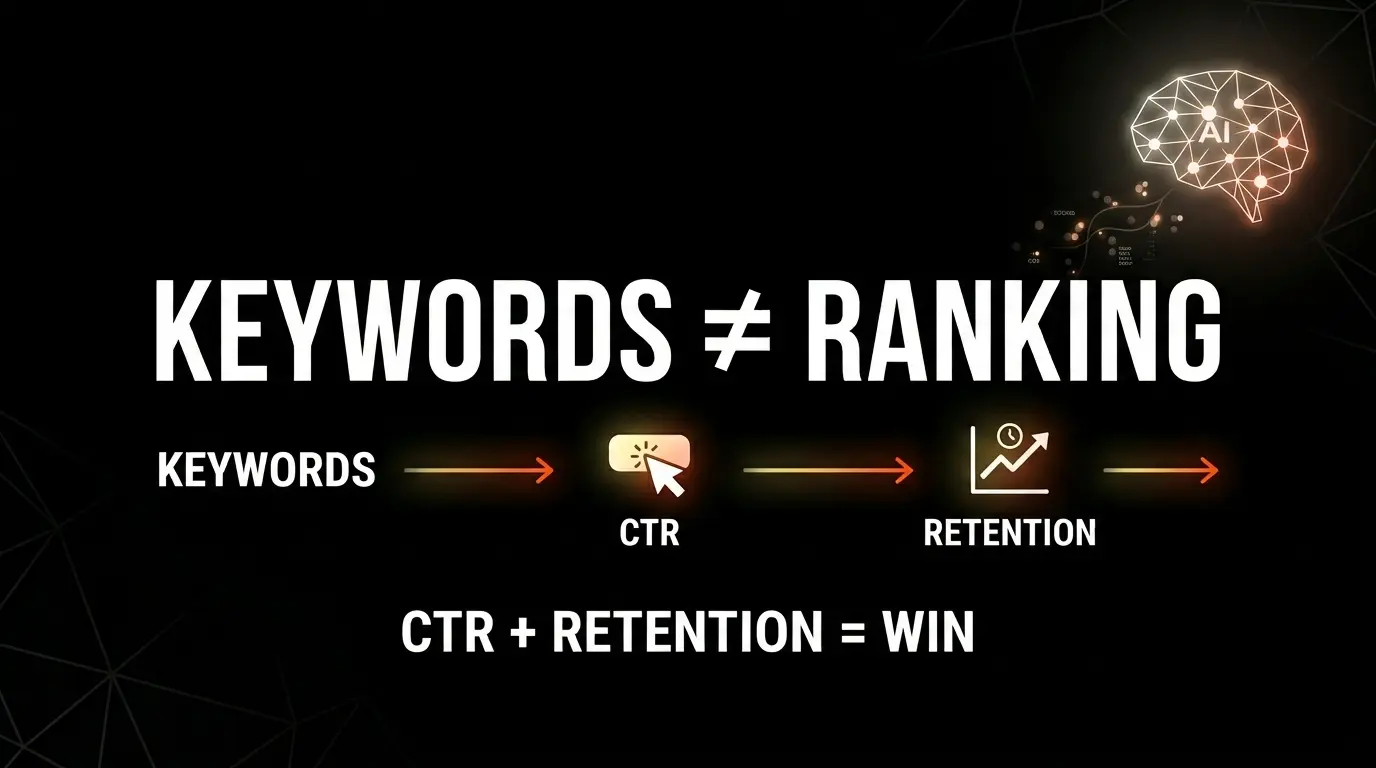
Once the video is surfaced in search results or the suggested feed based on its keyword profile, the ranking hierarchy is governed by behavioral validation signals. The algorithm meticulously tracks whether the audience actually clicks the video (Click-Through Rate, or CTR) and how long they remain engaged (Average View Duration, or AVD, and Retention Curves). If a video ranks highly for a targeted keyword but experiences a low CTR or massive viewer abandonment within the first 30 seconds, the algorithm immediately interprets this dynamic as a “failed intent match”. The video is subsequently deprioritized and removed from high-visibility search placements, regardless of how perfectly the metadata was theoretically optimized.
Advanced Algorithmic Metrics in 2026
In 2026, the algorithmic evaluation of keywords is deeply influenced by five advanced metrics and systemic shifts:
Hyper-Personalization and Semantic Matching: Artificial intelligence models no longer process search queries as isolated text strings; they evaluate the holistic meaning behind a query relative to the individual searcher. If a user searches for a broad term, the algorithm tailors the search results based on their historical watch behavior, device type, and time of day. Keyword research must therefore target specific micro-intents to capture distinct demographic segments accurately.
Viewer Satisfaction Signals: Beyond raw watch time, YouTube actively measures whether the user actually enjoyed the content through millions of micro-surveys distributed across the platform. Videos that score high in qualitative satisfaction retain their keyword rankings significantly longer, even if their technical keyword optimization is slightly less precise than a competitor’s.
Session Continuation and Platform Retention: The algorithm heavily weighs whether a video prompted the user to watch another video on the platform or if the content caused them to abandon the application altogether. Keywords that lead to prolonged session times are rewarded with broader algorithmic distribution.
Shorts Search Filtration: With the introduction of the dedicated Shorts filter in YouTube search functionality, SEO for short-form content has radically shifted. Keywords in titles and descriptions are now critical for Shorts discovery outside the standard swipe feed. For Shorts, the algorithm correlates the search query primarily with the “viewed-vs-swiped-away ratio” to establish long-term ranking.
The Triad of Traffic Sources: Keywords influence the three primary traffic sources differently: Search (relies heavily on exact keyword matches), Suggested (relies on semantic relevance within the same keyword cluster), and Browse (influenced by broad topical authority and past viewer history).
Ultimately, keywords function as the critical communication bridge between the content creator and the algorithm. They signal the exact premise, format, and target demographic of the video, allowing the algorithm to efficiently test the content against the intended audience.
How to Do YouTube Keyword Research (Step-by-Step)
The transition from conceptual understanding of the algorithm to practical execution requires a rigorous, systematic methodology. The following five-step architecture details how to uncover high-impact, low-competition keywords capable of driving sustainable organic growth.
Step 1 - Brainstorm Seed Keywords from Your Niche
Every comprehensive keyword map begins with the identification of seed keywords. Seed keywords are broad, foundational terms that define the core topics within a given industry, niche, or content category. Examples include broad industry identifiers such as “personal finance,” “Python tutorial,” “home workout,” or “vegan recipes”. Because these head terms possess massive global search volume and almost insurmountable competitive density from legacy channels, new or mid-sized channels should not expect to rank for them directly. Instead, seed keywords serve as the primary inputs for discovering highly targeted, long-tail variations.
The brainstorming process should bypass superficial assumptions and tap directly into raw user sentiment. In 2026, the most effective method for generating unique seed terms is “roleplaying” across the buyer or viewer awareness stages, mapping out exactly what a user struggles with before, during, and after a specific event.
To extract authentic user language, analysts must execute deep-dive mining across external platforms:
- Reddit and community forums: Subreddits dedicated to specific niches are invaluable repositories of keyword gold, revealing the exact, unfiltered terminology audiences use to describe their pain points
- YouTube comment sections: Mining the comments of top-performing competitor videos yields recurring questions, transactional queries, and specific format requests that standard SEO software frequently overlooks
- AI-powered categorization: Running these raw community inputs through AI models to categorize thematic struggles generates a robust list of 10 to 20 foundational seed keywords ready for algorithmic expansion
Step 2 - Use YouTube Autocomplete for Real Suggestions
Once a foundational list of seed keywords is established, they must be validated and expanded using YouTube’s native data infrastructure. The most reliable, unfiltered indicator of current viewer demand is the YouTube Autocomplete feature. When a seed term is entered into the platform’s search bar, the predictive engine drops down a list of related queries sorted dynamically based on real-time aggregate search frequency.
To extract maximum analytical value from the autocomplete function, strategists utilize the highly effective “underscore method”:
- Standard search: Shows what follows a typed word
- Underscore before keyword (e.g.,
_ keyword research): YouTube’s NLP engine reveals the pre-modifiers users type before the main term, surfacing phrases like “advanced keyword research,” “free keyword research,” or “beginner keyword research” - Underscore after keyword: Reveals the post-modifiers
Executing both directions provides a comprehensive, 360-degree landscape of high-intent, long-tail phrases that competitors relying solely on basic search inputs completely miss.
Finally, cross-referencing these expanded autocomplete suggestions with Google Trends ensures the keywords are not victims of decaying demand. Temporal mapping allows creators to verify whether an autocomplete suggestion is a sustained evergreen query, a seasonal spike, or a fleeting trend.
Step 3 - Analyze Search Volume and Competition
Accumulating a massive list of long-tail keywords is only productive if those keywords offer a statistical probability of actual ranking. A pervasive and fatal error in amateur keyword research is optimizing for raw search volume while entirely ignoring the competitive landscape.
Targeting a phrase with 50,000 monthly searches that is heavily dominated by incumbent channels with millions of subscribers yields zero impressions for a growing channel. A keyword with 8,000 searches, clear viewer intent, and weak competition is mathematically worth ten times more in actual traffic acquisition.
For validation, use these target ranges:
| Channel Size | Monthly Search Volume | Keyword Difficulty |
|---|---|---|
| New channels (under 10K subs) | 300 - 5,000 searches | Below 40/100 |
| Established channels (10K-100K subs) | 5,000 - 20,000 searches | Up to 60/100 |
| Authority channels (100K+ subs) | 20,000+ searches | Up to 80/100 |
In the absence of paid tools, the manual “search vs. results” gap method remains highly effective. Query a prospective keyword and analyze the total number of indexed video results. A keyword generating significant autocomplete interest but returning fewer than 10,000 highly relevant video results represents a massive systemic gap ready to exploit.
Advanced competition analysis in 2026 also involves “Outlier Detection”. By analyzing top competitors, strategists can identify their outlier videos - content that performs 5 to 10 times better than that channel’s average view count. These outliers signal a massive, untapped demand gap for that specific keyword cluster.
Use our YouTube Keyword Tool to automate volume and competition analysis instantly.
Step 4 - Check Search Intent
The mathematical validation of volume and competition is entirely irrelevant if the content format fails to satisfy the user’s underlying search intent. In 2026, YouTube’s neural networks rigorously classify queries into distinct intent categories, and misaligning the actual video content with these categories guarantees a rapid algorithmic demotion.
| Search Intent Type | Common Modifiers | Example Keyword | Ideal Video Format |
|---|---|---|---|
| Informational | How, what, why, guide, tips, tutorial | ”How to write a blog post” | Step-by-step tutorials or educational deep-dives |
| Commercial | Best, top, compare, vs, review, alternative | ”Best laptop for students 2026” | Comparative analysis, pros/cons, product testing |
| Transactional | Buy, order, download, discount, coupon | ”Buy MacBook Air M3” | Direct calls-to-action and clear affiliate links |
| Navigational | Brand names, specific channels | ”Rank Math login tutorial” | Specific destination or branded entity |
If a creator discovers a low-competition keyword for “best running shoes” (Commercial Intent) but produces a historical documentary on the evolution of footwear (Informational Format), the video will be swiftly abandoned by viewers. Checking the current top-ranking videos for a target keyword is a mandatory prerequisite to production. The format, length, and visual style that dominates the top three SERP positions dictate the exact content structure required to compete.
Step 5 - Build a Keyword Map for Your Channel
The culmination of the research process is the construction of a comprehensive keyword map - a strategic blueprint that shifts the channel’s focus from isolated, fragmented videos to an interconnected web of topical authority.
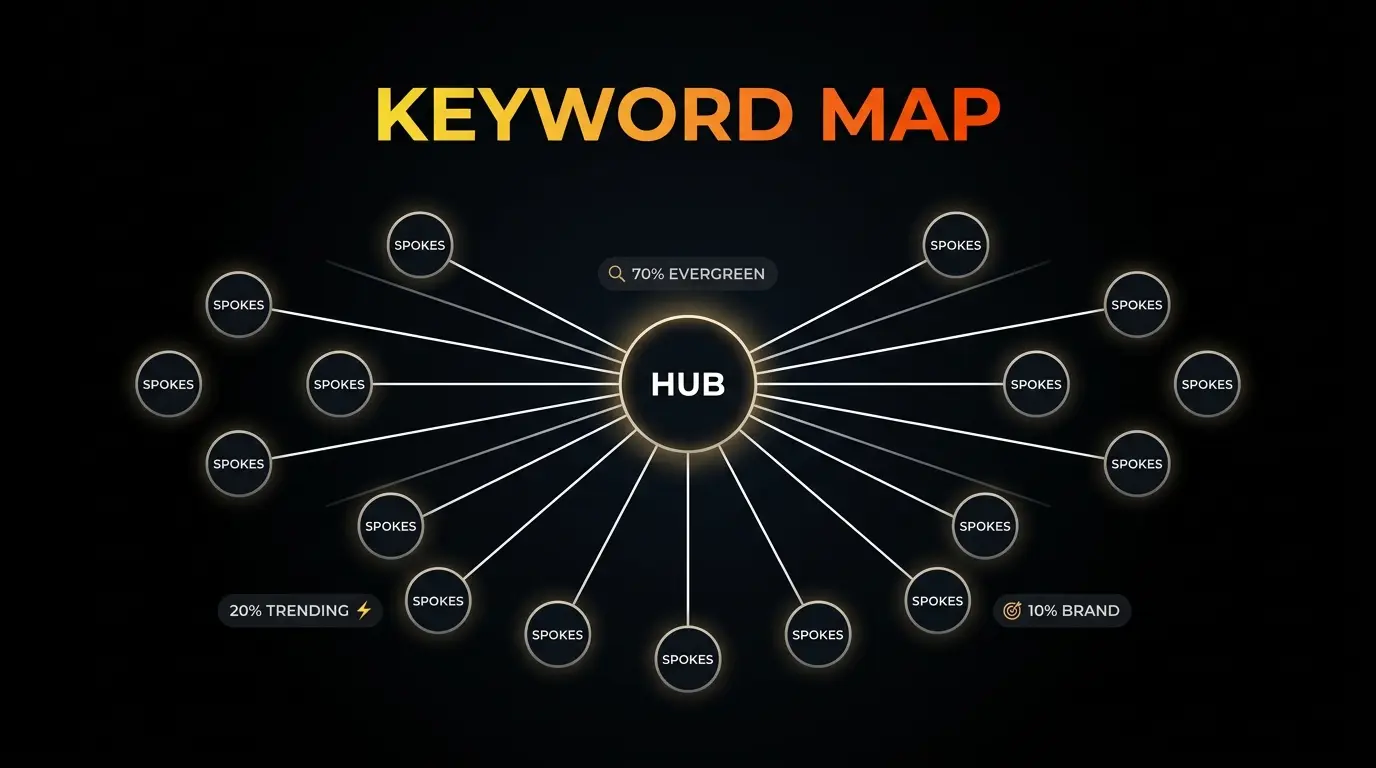
A keyword map organizes topics into a “hub-and-spoke” architecture. A broad, moderately competitive body term acts as the central hub (e.g., “Complete Guide to Choosing a Smartphone”), while highly specific, low-competition long-tail keywords serve as the supporting spokes (e.g., “best budget smartphone cameras under $300,” “smartphone battery life comparisons 2026”).
A balanced map allocates keyword types strategically:
- 70% of the calendar: Evergreen search terms (for long-term compounding growth)
- 20% of the calendar: Trending or timely topics (for short-term traffic spikes)
- 10% of the calendar: Brand or competitor analysis (for audience crossover)
For each planned video within the cluster, the map must dictate one Primary Keyword (placed in the title and core metadata) and 2 to 3 Secondary Keywords (integrated into the description, spoken audio, and chapters).
By executing this mapped architecture, a channel effectively dominates a specific semantic cluster, prompting YouTube’s suggested algorithm to seamlessly transition viewers from one spoke to the next, thereby exponentially increasing session time and solidifying channel-wide rankings.
Where to Place Keywords on YouTube
The meticulous curation of a keyword map yields no return on investment if the platform’s natural language processors cannot easily locate and parse the intended data. Strategic placement of exact-match and semantic keywords across the video’s architectural metadata is the fundamental mechanism by which initial algorithmic relevance is established.
Video Title
The video title remains the most critical deterministic signal for both algorithmic indexing and human engagement. Best practices for 2026 mandate that the primary target keyword must be front-loaded, ideally placed within the first 40 to 60 characters of the title string. This front-loading ensures the core subject matter is indexed with maximum priority by the crawler and prevents the critical keyword from being visually truncated on mobile devices.
However, a perfectly optimized title must simultaneously appeal to human psychology to generate the necessary Click-Through Rate (CTR) to sustain its ranking. Integrating “power words” - such as “ultimate,” “complete,” “surprising,” or “proven” - alongside the primary keyword has been empirically shown in wide-scale 2026 analyses to increase average CTR by 8.3%. For automated title optimization, use our YouTube Title Generator.
Description
The video description functions as a secondary indexing corpus that provides deep contextual framing for the algorithm. The first two to three lines are paramount; they are heavily weighted by the search engine and appear directly beneath the video title in standard search results.
- The primary keyword must appear naturally within the very first sentence
- The full description should consist of 200 or more words of original prose weaving in secondary keywords
- Embedding timestamps to create video chapters serves a dual SEO purpose - chapter titles containing secondary long-tail keywords are indexed independently by Google Search as distinct links
- Industry data indicates that well-structured chapters can increase average watch time by up to 11%
For optimized descriptions, try our YouTube Description Generator.
Tags
While their overarching algorithmic authority has diminished significantly in favor of behavioral metrics, tags remain a functional metadata component for edge-case categorization. The modern tagging strategy prioritizes strict relevance over sheer quantity:
- Deploy a maximum of 15 tags (5 to 10 being the optimal target)
- Follow the “Specific to Broad Pyramid” model: branded tags first, then exact-match tags, then broad category tags
- Never inject high-volume, irrelevant tags - the algorithm actively penalizes “tag stuffing”
- Long-tail tags are particularly effective for capturing common misspellings
Generate optimized tags automatically with our YouTube Tag Generator. For a complete tagging strategy, read our YouTube Tags Guide.
Channel Keywords
At the macro level, Channel Keywords dictate the overarching semantic entity of the entire account. Found within the backend channel settings, these keywords inform YouTube’s broader algorithmic understanding of the channel’s specific niche and topical authority.
Optimizing channel keywords aligns directly with the platform’s increasing reliance on E-E-A-T metrics. Establish a tight, highly relevant cluster of 7 to 10 core industry terms to define the channel’s perimeter of expertise, facilitating faster indexing and highly accurate recommendations in the Browse and Suggested feeds.
Spoken Words (Captions)
One of the most consequential advancements in YouTube SEO for 2026 is the deep integration of audio indexing. Google’s AI engines now ingest and parse the spoken transcript of a video with the exact same rigor applied to textual metadata.
- The primary keyword must be clearly verbalized within the first 30 to 60 seconds of the video
- Upload a custom, accurate SubRip Subtitle (SRT) file rather than relying on flawed auto-generated captions
- Custom captions correlate with average watch time increases of 7%, scaling up to 38% for mobile and international demographics
- Place a short, 2-to-3 word variation of the keyword directly on the thumbnail text for rapid visual comprehension
For accurate subtitle extraction from any video, use our YouTube Transcript Generator.
Best Free YouTube Keyword Tools (Compared)
The transition from theoretical strategy to empirical execution requires robust data analytics. While manual techniques like autocomplete mining provide directional guidance, determining exact search volumes, competitive density, and long-term temporal trends requires dedicated software.
| Tool | Best For | Key Feature | Pricing |
|---|---|---|---|
| Touhfa.art Keyword Tool | Fast, free keyword generation | Instant autocomplete analysis + competition scoring | 100% Free |
| YouTube Autocomplete | Zero-cost, real-time ideation | Captures exact, unfiltered user language directly on the platform | 100% Free |
| TubeBuddy | A/B testing and workflow optimization | Thumbnail and title A/B testing within the live YouTube interface | Free tier; Pro from ~$4.50/mo |
| VidIQ | Deep keyword research and trend prediction | Weighted competition scores based on channel-specific subscriber count | Free tier; Boost from ~$19/mo |
| KeywordTool.io | Massive long-tail semantic variations | Quick extraction of hundreds of keyword ideas with localized parameters | Free basic; Premium from ~$69/mo |
| Keywords Everywhere | Detailed insights overlaid on YouTube | Browser extension overlays search volume directly on the SERP | From ~$6/mo |
| Ubersuggest | Uniting website and YouTube discovery | Merges video optimization with traditional web SEO | Free tier with daily limits |
| AlsoAsked | Question-based search intent | Maps real, geo-specific questions users are asking | Free limited searches |
To bypass the friction of cross-referencing multiple platforms and consolidate research workflows, start your keyword research with our free tool to ensure optimal metadata alignment before production begins.
YouTube Tags vs Keywords: What Actually Matters More?
The pervasive debate regarding the relative importance of backend tags versus core keywords in titles and descriptions is largely a relic of older algorithmic iterations. In 2026, the data and official platform documentation are unequivocal: primary keywords embedded in titles, descriptions, and audio transcripts are exponentially more critical than backend tags.
The distinction lies in the fundamental algorithmic function of each element:
| Element | Algorithmic Weight | Function |
|---|---|---|
| Title Keywords | Very High | Drive NLP comprehension, establish core topic and ideal audience profile |
| Description Keywords | High | Provide deep contextual framing, enable chapter-based indexing |
| Spoken Keywords | High | Audio indexing reinforces metadata signals, confirms topic to AI |
| Backend Tags | Low | Categorization assistants and “Context Anchors” for edge cases |
| Hashtags | Low-Medium | User-facing navigational tools, Shorts categorization |
According to updated creator documentation, tags do not drive direct amplification. Injecting a massive, trending hashtag into a video will not magically force the algorithm to distribute the content to a wider audience if the core retention and CTR metrics are poor. Amplification decisions are driven purely by behavioral signals.
Tags retain utility exclusively for:
- Capturing common misspellings of a primary keyword
- Classifying hyper-specific niche identifiers (e.g., localized geospatial tags)
- Organizing branded content for internal channel playlists
Any tagging strategy that exceeds literal, highly relevant contextualization - such as copying 50 broad tags - is viewed by the 2026 algorithm as metadata spam. This practice actively damages the video’s retention curve by showing the content to unqualified audiences who immediately bounce.
A clear, descriptive title with relevant keywords accomplishes significantly more for categorization than any exhaustive set of tags. For optimized tag generation that follows these 2026 principles, use our Tag Generator. For the complete tag strategy breakdown, read our YouTube Tags Guide.
5 Keyword Research Mistakes That Kill Your Views
Even with access to enterprise-grade tools and extensive seed lists, strategic failures during the execution phase can completely neutralize the benefits of keyword research.
| Keyword Mistake | Why It Destroys Views | Required Fix |
|---|---|---|
| 1. Optimizing for Volume Over Intent | Targeting massive head terms dominated by millions of channels guarantees zero impressions for smaller creators | Research long-tail keywords with 300-5K searches and clear intent |
| 2. Writing Titles for Algorithms, Not Humans | Front-loading exact-match keywords in a robotic sequence satisfies crawlers but destroys human CTR | Integrate power words and emotional triggers for +20-40% CTR |
| 3. Mobile-Blind Thumbnails | Thumbnail text illegible on a 200x112 pixel mobile screen wastes every search impression | Test at mobile scale; ensure high contrast and minimal text |
| 4. Ignoring the First 30 Seconds | Failing to verbalize the target keyword and confirm the video’s premise causes instant viewer abandonment | Hook immediately with the keyword + a value promise |
| 5. Tag Stuffing with Irrelevant Terms | Packing descriptions and tags with trending but irrelevant terms confuses the AI and triggers spam penalties | Use only 8-12 highly relevant, niche-specific tags |
The most common thread across these failures is a fundamental misunderstanding of the platform’s hierarchy: creators attempt to game the metadata system rather than utilizing keywords to accurately connect high-quality content with the specific users seeking it. Transitioning from a mindset of “gaming the algorithm” to “satisfying viewer intent” is the definitive fix for all five errors.
Furthermore, neglecting to update the metadata on older, underperforming content prevents channels from capturing secondary traffic waves. Revisiting abandoned videos and optimizing their descriptions with current keyword data frequently revitalizes their search presence.
Frequently Asked Questions
How can YouTube creators leverage AI tools for keyword research?
In 2026, AI tools should be deployed primarily for semantic expansion and structural outlining rather than complete content generation. Strategists use AI to process raw Reddit threads and YouTube comments to extract thematic pain points and convert them into seed keywords. AI is also invaluable for outlining content briefs, identifying content gaps missed by competitors, and structuring timestamps. However, the actual video delivery must remain deeply human; heavily AI-generated content often feels generic and fails to generate the parasocial trust required for high retention and E-E-A-T signaling.
What role do long-tail keywords play in enhancing YouTube video visibility?
Long-tail keywords are the lifeblood of channel growth in 2026. Because short “head terms” are saturated, long-tail phrases (e.g., 3-to-5 word queries like “how to fix dishwasher not draining bosch”) capture highly specific search intents with significantly lower competition. These keywords boast higher conversion rates and establish a channel’s micro-authority. Furthermore, integrating these semantic variations throughout the description and audio transcript provides the AI with a dense contextual web, allowing the video to rank for dozens of tangential queries simultaneously.
Why should creators focus on watch-time metrics over search volume?
Search volume merely indicates potential theoretical reach, whereas watch-time metrics - specifically Average View Duration and Session Time - dictate algorithmic survival and practical visibility. The YouTube algorithm prioritizes viewer satisfaction; its primary objective is to keep users on the platform as long as possible. A video targeting a niche keyword with 1,000 searches that maintains a 75% retention rate will ultimately generate more algorithmic trust and long-term channel authority than a video targeting a massive 50,000-volume keyword that suffers an 80% bounce rate in the first minute.
How do search filters impact keyword optimization for Shorts?
The introduction of Shorts-specific search filters in 2026 has elevated the importance of traditional SEO for short-form content. Previously, Shorts relied almost entirely on the swipe-feed algorithm. Now, users actively search for Shorts tutorials and entertainment. Consequently, precise keywords in the Short’s title, description, and on-screen captions are mandatory for discovery outside the feed. Creators must ensure their short-form metadata accurately targets these quick-hit queries while maintaining a high viewed-vs-swiped-away ratio to sustain the ranking.
How can structured data improve YouTube video rankings?
Implementing VideoObject schema markup is a critical technical SEO tactic that bridges YouTube with the broader Google Search ecosystem. By embedding this structured data on external websites or blogs where the YouTube video is hosted, creators provide search engine crawlers with explicit, machine-readable data regarding the video’s exact upload date, duration, title, and core topics. This technical optimization makes the content highly eligible for coveted, high-visibility placements in Google Search carousels, AI Overviews, and featured snippets, thereby driving massive external traffic directly back into the YouTube architecture.
![YouTube Channel Comparison: Evaluate Any Two Creators for Free [2026]](/images/seo/youtube-channel-comparison/youtube-channel-comparison.webp)