YouTube Tags Best Practices 2026: How Many Tags, Limits, SEO Impact
Quick answer: YouTube tags still matter in 2026, but they play a minimal role in discovery compared with title, thumbnail, retention, and viewer satisfaction. The official hidden tag box allows up to 500 characters, and for most videos the practical range is 8-12 focused tags. More tags are not always better.
If you searched for terms like “youtube tags best practices 2026,” “youtube tags limit 2026,” or “how many tags should I use on YouTube,” this guide gives direct answers first, then the advanced strategy. It also clarifies the difference between hidden tags and visible hashtags, which many creators mix up.
YouTube Tags 2026: Official Limits and Best Practices (Quick Reference)
| Topic | Quick answer |
|---|---|
| Do YouTube tags still matter? | Yes, but they have a minimal role and mainly help with context, misspellings, and ambiguity. |
| YouTube tags character limit | 500 characters total in the hidden tag box. |
| Best number of tags | Usually 8-12 highly relevant tags. |
| Max number of tags | No fixed count cap, but the 500-character limit is the hard cap. |
| Tags vs hashtags | Tags are hidden metadata. Hashtags are visible and clickable in title/description. |
| Shorts tags best practice | Use clear hashtags (3-5) for Shorts discovery; hidden tags are secondary. |
This guide then shows how to structure tags correctly, avoid over-tagging, and apply niche-specific examples. You can also use our free Tag Generator tool for faster implementation.
What Are YouTube Tags?
YouTube tags are hidden pieces of metadata inputted through the YouTube Studio backend, distinct from the visible hashtags that appear in a video’s title or description. Historically, tags were the primary mechanism by which creators explicitly informed the search engine of a video’s subject matter. In the early iterations of the platform, populating the tag box with high-volume keywords directly manipulated search rankings, leading to widespread abuse and tag stuffing. However, the ecosystem has evolved significantly, rendering older strategies obsolete.
How the Algorithm Reads Tags in 2026
In 2026, the algorithm evaluates content through the lens of highly sophisticated artificial intelligence, utilizing frameworks akin to Google Cloud Video Intelligence. The platform now:
- Analyzes visual pixels frame-by-frame
- Transcribes audio to evaluate spoken keywords
- Assesses viewer sentiment to generate an automated understanding of the video’s subject matter
Because the AI is highly proficient at essentially “watching” and “listening” to the video, the overarching importance of manual tags has diminished for general categorization. YouTube’s official documentation explicitly states that tags currently play a minimal role in overall discovery, primarily functioning to correct misspellings or clarify semantic ambiguities.
Do YouTube Tags Still Matter in 2026?
Yes, but not in the old way. Tags are no longer a primary ranking lever. They are a support signal that helps YouTube when metadata or spoken context is unclear. If your title, thumbnail, and retention are weak, tags will not save the video. If your core signals are strong, tags can improve categorization accuracy.
That is why the most effective approach is: strong packaging first, then focused tag architecture. Think of tags as a precision layer, not a growth hack.
However, the assertion that tags are entirely obsolete is a dangerous oversimplification that costs creators millions of potential impressions. The advanced 2026 algorithm operates on a “Confidence Score” model. When a video is processed, the AI generates a confidence metric regarding its topic. If a creator uploads a video discussing the physiological benefits of “Cold Plunging,” the AI might initially generate a low-confidence categorization, oscillating between broader categories such as “Swimming,” “Winter Sports,” or general “Health.”
Tags as Relevance Confirmers, Not Ranking Boosters
By analyzing hidden tags such as “Biohacking,” “Ice Bath,” and “Andrew Huberman,” the algorithm achieves high confidence, correctly classifying the content into the highly specific sub-culture of physiological optimization.
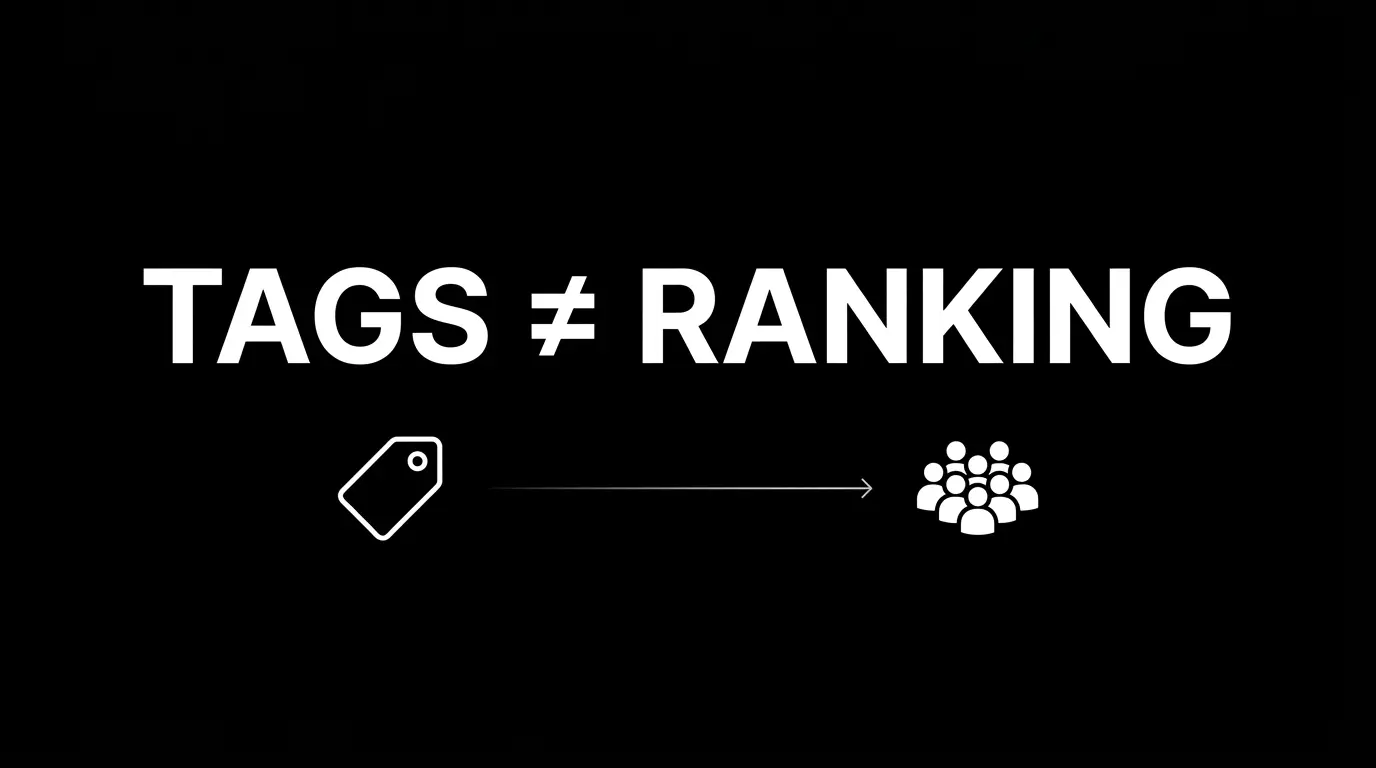
Tags function exclusively as relevance confirmers rather than ranking boosters. They do not artificially inflate a video’s position in search results; rather, they ensure the video is evaluated alongside the correct competitive cohort, preventing the disastrous retention drops that occur when a video is shown to an indifferent audience. They act as a Context Anchor, providing the tie-breaking signal when the AI is unsure of the exact audience demographic.
YouTube Tags vs Hashtags: Key Differences
The distinction between YouTube tags and visible hashtags is a frequent point of failure in modern optimization strategies. While both utilize keywords to categorize content, their technical formatting, algorithmic targeting, and strategic deployment are entirely divergent. For a comprehensive analysis of visible metadata, reference our dedicated YouTube Hashtags Guide.
| Feature | Tags (Hidden) | Hashtags (Visible) |
|---|---|---|
| Visibility | Hidden from viewers; viewable only via API or page source HTML | Highly visible; hyperlinked in titles and descriptions |
| Input Location | Dedicated “Tags Box” within YouTube Studio upload backend | Integrated directly within description text or video title |
| Formatting | Spaces permitted (e.g., “how to fix a sink”). No prefix required | No spaces. Must be preceded by ”#” (e.g., #PlumbingRepair) |
| Algorithm Target | YouTube Search, Suggested Videos, and Context Anchors | Hashtag Search pages, Shorts categorization, topical discovery |
| Ranking Paradigm | Relies on Channel Authority, exact-match queries, and watch time | Emphasizes Content Freshness, allowing smaller channels to rank quickly |
| Quantity Limits | 500 characters total, allowing for multiple phrases | 60 per description; algorithm only weights first 3-5 heavily |
When to Use Each
The optimal strategy in 2026 requires a bifurcated approach, utilizing both metadata types for their specific strengths:
YouTube Tags should be utilized to provide deep, invisible semantic context. They are the ideal location for embedding long-tail phrases, targeting common typographical misspellings, and establishing broad categorical anchors that would look unprofessional in a public-facing description. For a complete guide on writing SEO-optimized descriptions, see our YouTube Description Generator Guide.
Hashtags are user-facing navigational tools and short-term categorization signals. Deploy them when tapping into trending conversations, seasonal events, or established community clusters (e.g., #SmallYouTuberSupport). Because dedicated hashtag searches prioritize freshness over historical channel authority, they are vital for new channels capturing immediate traffic.
Pro tip: Use our Tag Generator for hidden tags AND our Hashtag Generator for visible hashtags to maximize SEO impact.
How Many Tags Should You Use?
The mathematical optimization of tag quantity requires balancing the platform’s technical limits against the algorithmic penalties for metadata dilution.
YouTube Allows 500 Characters
The platform permits a maximum of 500 characters within the hidden tag box. While you could theoretically input dozens of single-word tags to reach this limit, empirical data dictates a much more restrained, structured approach. Utilizing the full 500 characters often forces the inclusion of tangential or irrelevant keywords, which severely damages categorization precision.
Optimal: 8-12 Tags (Data-Backed)
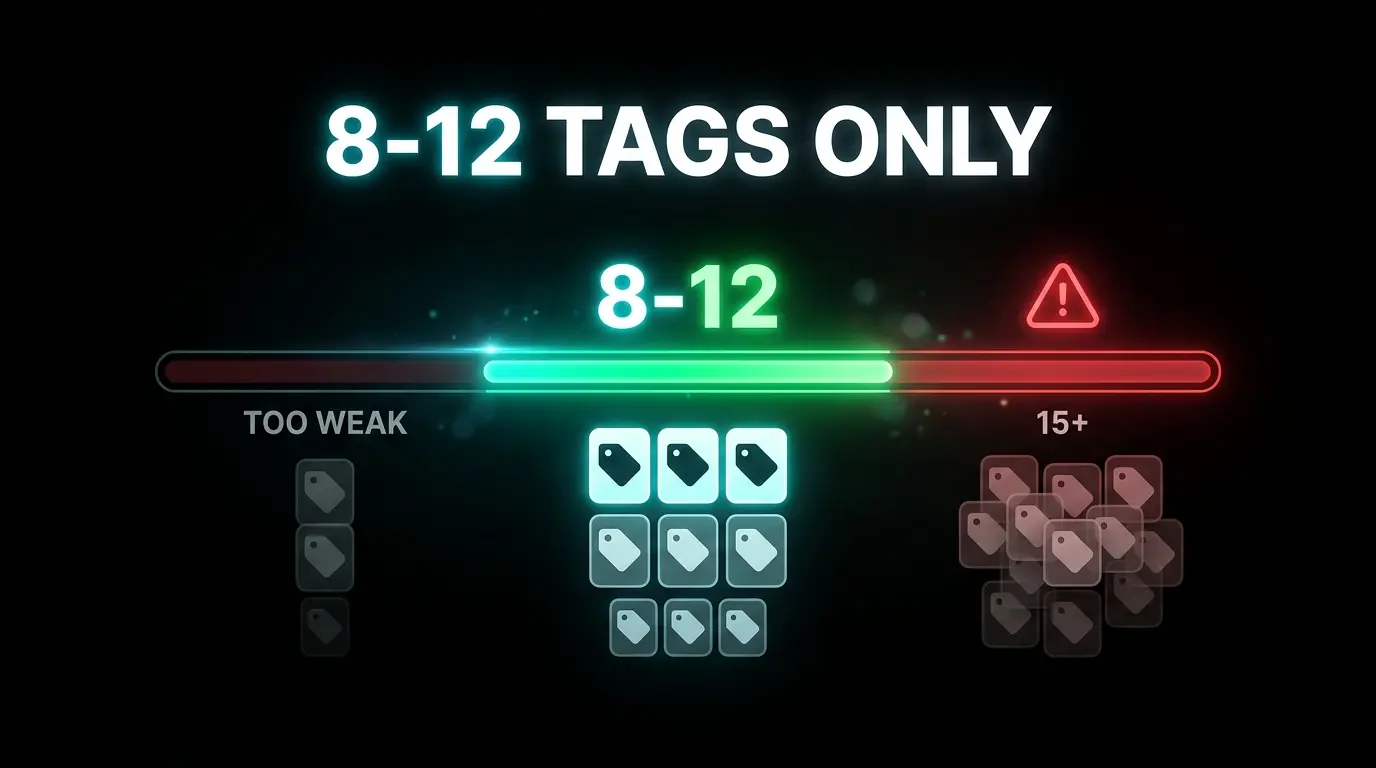
Extensive data analysis reveals that the highest-performing videos - those that consistently rank in YouTube search and secure placements in suggested video feeds - typically utilize between 8 and 12 highly focused tags. This range represents the optimal intersection of semantic breadth and topical density.
Research by SEO agencies indicates that the ideal length for individual tags is 2-3 words. Single-word tags (e.g., “business,” “money,” “food”) are too broad, forcing the video into unwinnable competition with massive channels. Excessively long phrases restrict search volume too severely to be mathematically viable.
Tag Hierarchy: Primary, Secondary, Broad
To maximize the efficacy of the 8-12 tag allowance, implement a strict 3-Layer Tag Hierarchy. The algorithm processes metadata sequentially, assigning significantly greater weight to the tags placed at the beginning.
| Layer | Function | Example (Topic: Budget Laptops) |
|---|---|---|
| Layer 1: Primary | Exact match of primary target keyword. Highest algorithmic priority. | ”best budget laptops for students 2026” |
| Layer 2: Secondary | Allied keywords and long-tail variations. Captures alternative queries. | ”cheap student laptops”, “laptops under 500” |
| Layer 3: Broad | Macro-environment tags. Connects to overarching platform categories. | ”technology”, “laptop review”, “student life” |
Diminishing Returns After 15 Tags
A critical error is assuming more metadata equals wider distribution. If you input 30 different tags spanning multiple sub-topics, the algorithm registers a diffused, unfocused signal. Data confirms that utilizing more than 15 tags results in steep diminishing returns, as the semantic weight of the primary keyword is diluted by sheer volume.
Maintaining a concise list of 8-12 highly relevant tags ensures the algorithm retains maximum confidence in the video’s core subject matter.
YouTube Tags Limit 2026: 500 Character Rule Explained
The platform enforces the limit by characters, not by a fixed number of tags. You can add many short tags or fewer long-tail tags, but once you hit 500 total characters, additional input is rejected.
For SEO, filling all 500 characters is not automatically better. In practice, focused metadata often performs better than bloated lists, because relevance quality matters more than raw quantity.
How to Find the Best Tags for YouTube
Discovering the most potent tags requires moving entirely beyond assumption and utilizing data-driven extraction methods. Tags that performed well in 2025 may represent entirely dead traffic in 2026.
YouTube Search Autocomplete
The most reliable, zero-cost source of high-intent tags is YouTube’s native Search Autocomplete. When you type a seed keyword into the search bar, the dropdown auto-populates with the most frequent, currently trending queries. These are algorithmic outputs generated by analyzing millions of real-time user keystrokes.
The “Snowball Trick”: Take a primary topic (e.g., “microphone setup”), input it into the search bar, and extract the top autocomplete suggestions (“microphone setup for streaming,” “microphone setup for podcasting”). These multi-word phrases form the perfect secondary layer. Focusing on autocomplete queries with 4+ words drastically reduces competition while ensuring high viewing intent.
Competitor Tag Extraction
Hidden tags are accessible via page source HTML or public APIs, making competitor analysis a cornerstone of professional tag optimization. Identify 3-5 top-performing creators in your niche and analyze videos published within the last 90 days.
By examining the underlying HTML of a competitor’s watch page (searching for the keywords meta property) or using browser extensions, you can extract the exact tag sequences driving millions of views. These tags shouldn’t be blindly duplicated - they serve as a diagnostic tool to understand how top creators signal the algorithm.
To streamline this process, use our Tag Extractor tool to automate the HTML parsing.
YouTube Studio Analytics
For established channels, the most valuable keyword data resides within YouTube Studio. Navigate to Analytics > Traffic Sources > YouTube Search to view the exact search terms viewers currently use to discover your content.
If a video designed to target “home workouts” is gaining traction from “no equipment cardio routines for apartments,” that exact phrase must be immediately added to the tag box AND used as a primary tag for future content. Reinvesting proven search terms back into the tagging strategy creates a self-reinforcing loop of algorithmic relevance.
Our Free Tag Generator Tool
Manual research is effective but exceptionally time-consuming. Our free Tag Generator automates the autocomplete extraction process, analyzes competitor metadata, and filters results based on real-time 2026 search volume and competition metrics. It outputs a balanced, mathematically optimized list of primary, secondary, and broad tags - completely eliminating guesswork.
Best YouTube Tags by Niche [2026]
A tagging architecture that dominates in gaming will fail in education. The algorithm evaluates categorical relevance with extreme prejudice. Below is an exhaustive breakdown across the five most competitive verticals.
Gaming Tags
The gaming vertical is characterized by extreme competition and rapid trend cycles, requiring tags that blend broad platform markers with specific game titles and common misspellings.
| Tag Category | Strategic Application | Examples |
|---|---|---|
| Exact Game Specifics | Identifies the core IP and iteration | ”Minecraft 1.21 update”, “GTA 6 gameplay trailer”, “Valorant competitive 2026” |
| Format Identifiers | Informs the algorithm of video style | ”Lets play”, “esports highlights”, “indie game review”, “speedrun world record” |
| Hardware & Platform | Captures hardware-specific audiences | ”PC gaming ultra settings”, “PS5 gameplay 4k”, “Xbox Series X review” |
| Misspelling Capture | Exploits rapid typing errors | ”Fortnight”, “Pleystation”, “Steem”, “gamming” |
Music Tags
Music requires differentiation between original productions, covers, tutorials, and official releases.
| Tag Category | Strategic Application | Examples |
|---|---|---|
| Content Format | Separates professional from fan content | ”official music video”, “lyric video 2026”, “live performance acoustic” |
| Creator Identity | Establishes role in the music ecosystem | ”independent artist”, “music producer vlog”, “singer songwriter original” |
| Genre & Mood | Targets specific sub-genres | ”lofi hip hop beats to study to”, “synthwave mix 2026”, “modern country playlist” |
| Production Education | Captures technical creation audience | ”FL studio 21 tutorial”, “vocal mixing tips for beginners” |
Comedy/Entertainment Tags
Comedy is notoriously difficult for the algorithm to parse via audio transcription alone. Sarcasm, irony, and physical comedy don’t translate to text analysis - making hidden tags absolutely vital.
| Tag Category | Strategic Application | Examples |
|---|---|---|
| Sub-genre Anchors | Defines exact humor style | ”stand up comedy special”, “sketch comedy group”, “public prank video” |
| Format Identifiers | Targets binge-watching structures | ”funny moments compilation”, “try not to laugh challenge impossible” |
| Cultural Context | Taps into internet culture and memes | ”relatable memes for students”, “political satire 2026”, “dark humor jokes” |
| Broad Categorization | Stays in entertainment suggested feeds | ”comedy”, “funny”, “entertainment”, “humor” |
Tech/Review Tags
Technology channels survive on high-intent Search traffic. Consumers use YouTube as a search engine before purchasing decisions.
| Tag Category | Strategic Application | Examples |
|---|---|---|
| Exact Product Names | Targets specific model, avoids broad terms | ”iPhone 17 Pro Max titanium”, “Samsung S27 Ultra camera test” |
| Purchase Intent | Captures bottom-of-funnel viewers | ”[Product] honest review 2026”, “is [Product] worth it” |
| Comparison & Versus | Exploits decision friction | ”[Product A] vs [Product B]”, “best budget laptops 2026” |
| Pain-Point Resolution | Targets desperate technical support | ”how to fix [Product] battery drain”, “iOS 19 hidden features” |
Education/Tutorial Tags
Educational content relies on evergreen, long-tail search traffic that compounds over years.
| Tag Category | Strategic Application | Examples |
|---|---|---|
| Question-Based | Matches exact human curiosity structure | ”how to edit videos in premiere pro fast”, “what is AI explained” |
| Skill Level | Prevents experts clicking beginner content | ”for complete beginners”, “step by step tutorial slow” |
| Outcome-Based | Focuses on the result the viewer desires | ”how to grow on youtube 2026”, “pass the CPA exam first try” |
| Broad Educational | Connects to platform educational ecosystem | ”tutorial”, “education”, “masterclass”, “online learning” |
YouTube Shorts Tags Strategy
The optimization of short-form vertical video requires a fundamental paradigm shift. Strategies that guarantee success for ten-minute videos will actively suppress a fifteen-second Short.
Short-form vs Long-form Tag Differences
When a long-form video is published, hidden tags help the algorithm index the video for future search queries over months or years. When a YouTube Short is published, it’s immediately placed into the Shorts Feed and shown to a small, curated test audience. The algorithm measures the exact “swipe-away rate” within the first few hours.
In this volatile environment, hidden tags play a subordinate role while visible hashtags become paramount. If a creator uploads a rapid-fire meal prep Short with hashtags #MealPrep and #BudgetCooking, YouTube shows the video to viewers who recently engaged with food content. If the test group watches without swiping away, distribution scales exponentially. If the hashtags are incorrect, the Short flatlines permanently.
Viral Shorts Tag Formulas
The optimal 2026 formula involves utilizing 3-5 visible hashtags in the description:
- The Mandatory Categorizer: #Shorts or #YouTubeShorts must be included on every vertical upload
- The Niche Identifiers: 2-3 highly specific tags related to content (e.g., #Woodworking, #DIYFurniture)
- The Trending Tag: 1 optional tag tapping into a current trend or challenge, provided it’s contextually relevant
Strictly avoid spamming #viral, #fyp, or #trending on every Short. These generic tags provide zero useful categorization data because millions of diverse videos use them simultaneously, rendering them algorithmic noise.
For a complete breakdown of hashtag integration in vertical formats, reference our YouTube Hashtags Guide - Shorts Section.
YouTube Tag Best Practices [2026]
1. Front-load Your Primary Keyword
The sequence of tags is algorithmically significant. The crawler reads metadata sequentially, assigning the highest weight to the very first tag. If your goal is to rank for “best budget laptops 2026,” the first tag in the hidden box must be precisely that phrase. Placing broad terms like “youtube” or “video” first dilutes intent.
2. Mix Exact-Match + Long-Tail
Relying solely on broad exact-match keywords (e.g., “fitness,” “marketing”) guarantees burial beneath established legacy channels. The modern strategy: a calculated blend of exact-match terms and highly specific, multi-word long-tail queries.
Long-tail tags (e.g., “how to fix dishwasher not draining bosch silence plus”) capture viewers with exceptionally high intent and face a fraction of the competition. As viewers transition toward descriptive voice searches, long-tail tags have become the primary growth driver for channels under 100K subscribers.
3. The “Misspelling Goldmine” Strategy
One of the few areas where hidden tags provide an asymmetrical advantage. With voice search, rapid mobile typing, and auto-correct failures, users frequently input phonetically inaccurate queries (“ChatGBT,” “Shorst,” “Entreprenur”).
The hidden tag box serves as the perfect, invisible receptacle for these variations. Ranking for misspelled keywords provides access to zero-competition traffic streams. Google’s documentation confirms tags are highly useful for capturing this specific traffic subset.
4. Update Tags on Old Videos
Metadata is not static. A flatlined video can often be revived by updating hidden tags to reflect current nomenclature. If a tutorial previously tagged with “Home Cooking Ideas” now aligns with “Budget Meals for Inflation” - update immediately.
This “Evergreen Refresh Formula” signals to the system that the content is relevant to current queries, placing older, high-retention videos in front of a modern audience.
5. Never Copy-Paste Same Tags
While 1-2 branded tags (channel name, series title) should be consistent across uploads, copy-pasting the exact same block of 15 tags across every video destroys the algorithm’s ability to differentiate. Each video addresses a unique sub-topic, and the tags must reflect that specific nuance. Metadata homogenization leads to cross-cannibalization and eventual suppression.
Common Tag Mistakes to Avoid
1. Irrelevant Tags = Algorithmic Punishment
The most destructive mistake: “tag stuffing” with popular, high-volume keywords that have zero relevance to the actual content. If a classical architecture video is tagged with “bikini, beaches, viral prank, MrBeast,” the algorithm may temporarily show it to those audiences. When they immediately click away, the resulting spike in swipe-away rates registers as deceptive content - resulting in permanent suppression.
2. Too Few Tags = Missed Discovery
While overstuffing is penalized, using zero tags or only one broad keyword leaves the AI without an adequate Context Anchor. Massive creators can afford to ignore tags due to baked-in authority, but smaller channels cannot. An empty tag box significantly increases the likelihood of miscategorization.
3. Ignoring YouTube Studio Data
Tags should never be selected based on assumption. Audit your YouTube Studio “Search Terms” report regularly. Stop using conceptual tags generating zero impressions while ignoring the actual phrases viewers use to find your channel. Failing to adapt ensures stagnation.
Free YouTube Tag Generator Tool
Executing the multi-layered strategies outlined above without expending hours on manual research requires automation.
Generate Your Tags Instantly - 100% Free
How Our Tool Works
Our Tag Generator is engineered for the restrictive 2026 YouTube search environment. Input a primary video topic, and the tool:
- Queries current search autocomplete data
- Analyzes top competitor metadata structures
- Cross-references keyword difficulty metrics
- Compiles a copy-paste-ready sequence optimized for the 500-character limit
3-Layer Approach Built-In
Unlike generators that output a disorganized wall of generic keywords, our tool executes the algorithmic 3-Layer Approach:
- Layer 1: Automatically front-loads the exact-match primary keyword
- Layer 2: Populates secondary long-tail phrases and identifies relevant misspellings
- Layer 3: Concludes with broad category tags for macro-level classification
No signup. No payment. No limits.
Frequently Asked Questions
Are hidden YouTube tags still relevant in 2026?
Yes, but their function has evolved significantly. They are no longer primary ranking boosters that single-handedly force videos to the top. Instead, they act as vital Context Anchors that assist the AI in categorizing content when automated analysis yields a low confidence score. They remain absolutely essential for capturing traffic from common typographical misspellings.
What is the precise difference between tags and hashtags?
Hidden tags are inputted within YouTube Studio, allow spaces, possess a 500-character limit, and assist in invisible semantic categorization for search and suggested feeds. Hashtags are visible links in titles or descriptions, require a ”#” prefix with no spaces, and are used for trending discovery, Shorts categorization, and hashtag-specific search pages.
How many tags should I use on a YouTube video?
The optimal range is 8-12 highly relevant tags, typically consisting of 2-3 word phrases. Utilizing more than 15 tags dilutes semantic weight and can trigger algorithmic confusion, causing distribution to irrelevant audiences.
Should I use the maximum 500-character limit?
No. Maximizing this limit almost always requires stuffing with irrelevant or broad terms. It is vastly superior to use 200-300 characters of hyper-focused, relevant tags than all 500 characters on diluted metadata that confuses the Context Anchor.
How do I order my tags for maximum SEO impact?
Follow the sequential 3-layer hierarchy. The first tag must be the exact match of your primary target keyword. Subsequent tags should be secondary long-tail variations and common misspellings, followed by broad category identifiers at the end.
Do hidden tags matter for YouTube Shorts?
For Shorts, visible hashtags in the description are vastly more important than hidden backend tags. Hashtags actively aid the algorithm in matching the Short to its critical initial test audience. Hidden tags provide minimal impact on Shorts viral velocity, though they slightly assist in standard search indexing.
Can misleading tags get my channel penalized?
Absolutely. Using popular but irrelevant tags constitutes metadata abuse. When viewers click away due to the mismatch, the resulting low retention rates send a massive negative signal, permanently suppressing the video’s distribution.
How can I find the best tags for my specific niche?
The most effective methods: use YouTube Search Autocomplete for long-tail phrases, examine competitor hidden tags via page source HTML or our Tag Extractor, review YouTube Studio Search Terms reports, and use our Tag Generator to automate extraction of proven, high-performing keywords.
![YouTube Channel Comparison: Evaluate Any Two Creators for Free [2026]](/images/seo/youtube-channel-comparison/youtube-channel-comparison.webp)