YouTube Title Generator: Create Viral Video Titles [2026]
Comprehensive analysis of platform data reveals a startling distribution of viewership: between 88.4% and 91% of all videos uploaded to YouTube fail to reach the foundational milestone of 1,000 views. Data from the Pex search engine analysis indicates that 96.9% of all videos reach fewer than 10,000 views, 99.3% fail to cross the 100,000-view threshold, and a mere 0.64% of the platform’s total content generates more than 100,000 views.
This extreme inequity in viewership is rarely a consequence of poor production value. Highly researched, expertly edited videos are routinely relegated to algorithmic obscurity. The fundamental failure point occurs at the very first interaction: the title. Weak, unoptimized, or vague video titles generate a click-through rate (CTR) approaching zero, regardless of the intrinsic quality of the underlying video.
The solution lies in engineering titles that satisfy both the sophisticated natural language processing (NLP) architectures of the 2026 recommendation engine and the primal neurological triggers of human curiosity. This guide serves as the definitive resource for mastering video title optimization, accompanied by our free YouTube Title Generator tool.
Why Your YouTube Title Is the Most Important Metadata
The platform has evolved beyond a traditional search index into a hyper-personalized, AI-powered prediction engine. Its primary objective is to accurately predict which specific video will yield the highest “Viewer Satisfaction Score” for an individual user at a specific moment.
Title = #1 Ranking Factor
The title is explicitly recognized as the number one ranking factor because it provides the algorithm with its initial semantic context. Before a video accumulates behavioral data - such as Average View Duration (AVD), retention curves, or engagement metrics - the system relies entirely on NLP to parse the title, description, and auto-generated transcripts.
In 2026, YouTube runs thousands of simultaneous micro-tests, displaying a newly uploaded video to a small, targeted batch of users based on their watch history and the semantic associations found in the video’s title. If the title accurately signals the content’s value:
- Video passes the test and is pushed to broader audience clusters
- If poorly constructed, the video is shown to an incompatible audience, fails, and experiences rapid algorithmic suppression
CTR Impact: Title Creates the First Impression
The title generates the viewer’s absolute first impression. Optimization of the title alone is empirically responsible for an estimated 15% to 25% lift in overall CTR. In the 2026 ranking hierarchy, CTR carries a “High” weighted value, acting in tandem with Average View Duration to form the ultimate winning formula.
Algorithm Reads Title FIRST
The algorithm reads the title first, utilizing it as a predictive filter before any other behavioral signal can be generated. If the title fails to arrest the viewer’s attention during the infinite scroll, the thumbnail is ignored, the content remains unwatched, and the video’s quality becomes statistically irrelevant.
YouTube Title Best Practices [2026]
1. Front-load Your Target Keyword
The architecture of modern NLP models and human reading patterns share a common trait: they heavily prioritize the beginning of a sentence. Front-loading requires placing the primary target keyword within the first 5 words (approximately the first 40 characters).
In the 2026 algorithm, keyword optimization has transitioned from archaic exact-match density to sophisticated “intent alignment.” The system evaluates whether the front-loaded terminology clearly satisfies the underlying motivation of the user’s search.
Good: “5 Camera Settings That Fix Blurry Photos” Bad: “How You Can Finally Fix Blurry Photos With These 5 Camera Settings”
2. Keep It Under 60 Characters
While YouTube permits titles up to 100 characters, established best practices dictate restricting length to 60 characters or fewer. Titles exceeding this threshold are truncated on mobile devices - which account for the vast majority of consumption.
Truncation replaces the end of your title with an ellipsis, effectively destroying carefully constructed psychological hooks. If the primary catalyst for curiosity is at the end of a 90-character title, mobile viewers will never see it.
3. Use Numbers and Power Words
Numerals - particularly odd numbers - stand out visually against alphabetical characters, creating a pattern interrupt that arrests scrolling. Power words function as emotional catalysts:
| Psychological Trigger | Mechanism | High-Converting Power Words |
|---|---|---|
| Anticipation & Curiosity | Creates cognitive tension and urgency | Rush, Exclusive, Secret, Revealed, Shocking, Hidden |
| Trust & Authority | Reduces skepticism, establishes credibility | Proven, Certified, Guaranteed, Authentic, Scientific |
| Efficiency & Ease | Appeals to desire for maximum return on minimal investment | Effortless, Blueprint, Hacks, Instant, Painless, Quick |
| Motivation & FOMO | Inspires action, leverages fear of missing out | Conquer, Ultimate, Unstoppable, Vital, Epic, Game-Changer |
4. Create a Curiosity Gap
The “Curiosity Gap” leverages the neurological mechanisms of the human dopamine system. When a title highlights a specific, compelling piece of missing information, it creates immediate cognitive tension.
- Too narrow (overly descriptive): viewer has no reason to click
- Too wide (obscure): induces confusion rather than curiosity
- Optimal: Bold declaration, unexpected question, or specific detail without revealing the resolution
Examples: “Why Don’t We Shoot Nuclear Waste Into Space?” or “1,000,000 Dominoes Falling is Oddly Satisfying”
5. Never Mislead (Clickbait vs Value-Bait)
The most fundamental paradigm shift in 2026 is the aggressive prioritization of Viewer Satisfaction over raw click metrics.
| Aspect | Clickbait (Bad) | Value-Bait (Good) |
|---|---|---|
| Promise | Exaggerated, misleading | High-arousal but honest |
| Delivery | Disconnected from content | Delivers on the promise |
| CTR | High initially | High consistently |
| Retention | Viewers abandon immediately | Viewers watch fully |
| Algorithm Result | Permanent suppression | Exponential growth |
High CTR must be paired with high retention. Titles must be aggressively optimized for psychological engagement while maintaining absolute thematic integrity.
YouTube Title Formulas That Get Views
Top-performing videos adhere to replicable, structured formulas. These frameworks leverage established psychological triggers to generate disproportionate engagement.
The “How To” / Blueprint Formula
Structure: [Possessive Pronoun] <System/Blueprint/Framework> for <Specific Outcome>
This formula signals comprehensive, replicable methodology rather than disconnected tips. Example:
- Generic (weak): “My Blueprint for YouTube Growth”
- Optimized (strong): “The Blueprint to Make $$$ on YouTube from Day 1”
The specificity of the outcome transforms a vague promise into a credible, actionable preview. This structure is exceptionally potent for B2B and educational audiences.
The “List” / Compression Formula
Structure: <Massive Amount of Value> in <Constrained Timeframe>
Appeals directly to time-constrained audiences who demand extreme efficiency. Example:
- “30 Years of Business Knowledge in 2hrs 26mins”
- “7 Beginner Mistakes That Kill Your Channel (Fix Them Today)”
Precise numbers forge an implicit mental contract that the content will respect the viewer’s time.
The “Challenge/Experiment” Formula
Structure A: I Tried [Extreme Action] for <Duration>
Structure B: <Confrontational Statement> + <Identity Trigger>
Thrives on empathy, identity, and narrative anticipation. Examples:
- “I Trained Like a NASA Astronaut for 30 Days”
- “You’ve Consumed Enough. It’s Time to Start Creating”
The “Versus” Formula
Structure: <Option A> vs <Option B>: <Specific Use Case / Year>
Captures highly motivated, bottom-of-the-funnel audiences seeking resolution to complex decisions. Examples:
- “Premiere Pro vs DaVinci Resolve 2026”
- “Notion vs Obsidian for Students”
Adding temporal markers or specific use-case parameters dramatically reduces competition.
The “Secret/Reveal” Formula
Structure: What They Aren't Telling You About <Topic> or The [Adjective] Secret to <Outcome>
Leverages exclusivity, insider knowledge, and institutional distrust. Examples:
- “The Untold Secret of the Mona Lisa”
- “What No One Tells You About Starting a Channel”
This generates massive CTR by exploiting the human discomfort associated with informational deficits.
YouTube Shorts Title Strategy
The short-form and long-form algorithms are architecturally separated, requiring entirely distinct titling strategies.
Short Titles for Short Videos
Because Shorts are consumed in rapid succession, the title serves a secondary support role. The algorithm evaluates Shorts based on:
- Swipe-through rate: Whether the viewer engages in the first 0.5 seconds
- Loop rate: How frequently the Short is re-watched
Lengthy titles that overlay the bottom third of the vertical video disrupt the visual experience. Shorts titles must be exceptionally concise.
Viral Shorts Title Formulas
Viral Shorts titles act as immediate, low-friction contextual anchors:
- POV: “POV: You’re a Chef Who Can’t Cook”
- Transformation: “How I [result] in [timeframe]”
- Curiosity: “Wait Until You See This [topic] Trick”
- Relatability: “Every [person] Does This Wrong”
- Lists: “[n] [topic] Facts You Didn’t Know”
Hashtags in Shorts Titles
Hashtags serve strictly as categorization metadata, not amplification mechanisms. Applying generic tags like #Viral or #FYP provides zero unique classification data.
Use 2-3 niche-specific hashtags (e.g., #BudgetCooking, #MechanicalKeyboard) that assist the algorithmic matching process. For complete hashtag strategy, see our YouTube Hashtags Guide.
YouTube Title SEO Checklist
Consistent channel growth requires standardized upload processes. Use this diagnostic checklist for every video:
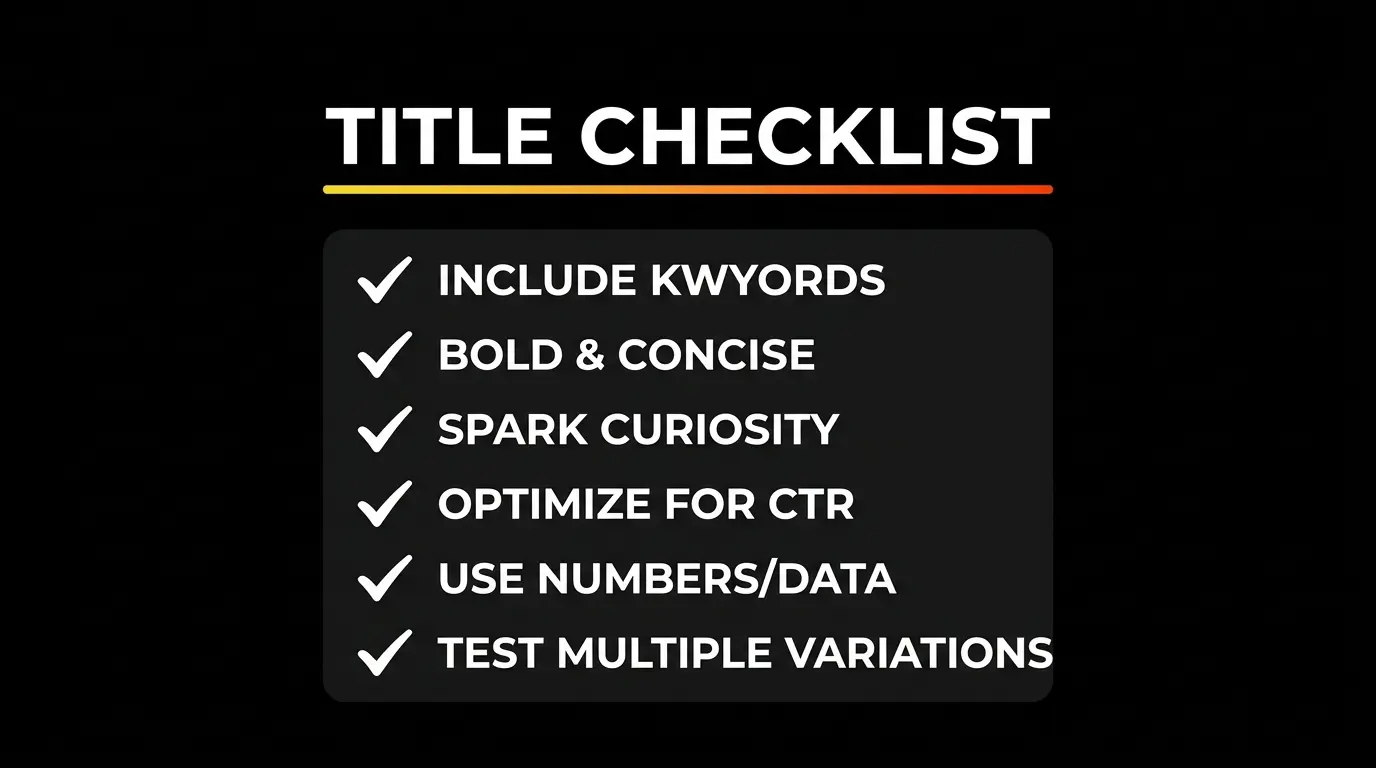
- Primary keyword in first 5 words - Guarantees accurate semantic parsing and immediate UI visibility
- Under 60 characters - Prevents mobile truncation that destroys context and curiosity gaps
- Match search intent exactly - Check YouTube autocomplete suggestions to ensure your title addresses viewer motivation
- Power word included - At least one emotional trigger word (secret, proven, ultimate, shocking)
- Number included (when relevant) - Specific numbers boost CTR and set viewer expectations
- No misleading claims - Title must accurately represent the content (value-bait, not clickbait)
- A/B test with YouTube Studio - Test up to 3 variations; allow 14 days to reach 95% statistical confidence
- Tags optimized - Use our Tag Generator to complement your title with hidden metadata
Common Title Mistakes That Kill Views
1. All Caps = Spam Signal
All-caps titles don’t affect NLP indexing directly, but they severely degrade perceived professionalism. This results in diminished CTR, which causes algorithmic suppression. Use standard Title Case for superior legibility and trustworthiness.
2. Too Vague = Low CTR
Titles like “My Thoughts on This” or “Update Video” provide neither search engines nor viewers with sufficient data. The algorithm cannot identify a viable seed audience, causing immediate filtering.
3. Keyword Stuffing = Algorithmic Penalty
Titles like “YouTube SEO Tips 2026 | Best YouTube SEO Strategy for Beginners YouTube” trigger spam detection in 2026’s semantic deep-learning models. Furthermore, robotic titles repel human viewers, causing catastrophic CTR drops.
4. Changing Title After Publishing
Strategic iteration is healthy if initial metrics indicate failure. The 48-hour rule: if CTR remains below 3% after 48 hours, replacing the title is a necessary corrective measure. However, modifications force re-indexing, which may cause short-term search traffic fluctuations. Make changes singular and purposeful.
Free YouTube Title Generator Tool
The sheer volume of content necessary to sustain algorithmic momentum demands extreme efficiency. AI title generation tools resolve the psychological bottleneck of manual ideation.
Generate Your Titles Instantly - 100% Free
How Our AI Tool Works
Our Title Generator deploys sophisticated language models that:
- Analyze current trending videos and extract winning structural patterns
- Apply power words and optimize character length automatically
- Integrate structured curiosity gaps based on proven formulas
- Generate 10 unique titles across multiple formats: listicle, how-to, curiosity, story, viral, comparison
- Color-code titles by length: green (optimal), yellow (acceptable), red (too long)
Instant Title Ideas from Any Topic
Input your video topic and optional keywords. The tool outputs a balanced mix of title formulas - each combining SEO intent alignment with the psychological frameworks detailed in this guide. No signup. No payment. No limits.
Complete your video SEO with our Tag Generator for hidden metadata, Hashtag Generator for visible categorization signals, and our YouTube Description Guide for writing SEO-optimized descriptions that pair perfectly with your titles.
Frequently Asked Questions
Does capitalization in YouTube titles affect algorithmic ranking?
Title capitalization does not directly influence SEO indexing or algorithmic ranking. The deep-learning search engine processes text semantically regardless of case. However, capitalization significantly influences human CTR. Standard “Title Case” is recommended to maximize professional aesthetics without triggering spam aversion.
How do AI title generators construct titles?
Modern AI title generators utilize transformer-based large language models (LLMs). These models ingest your topic and analyze it against vast datasets of high-performing content, calculating token sequences that maximize both search relevance and psychological appeal - factoring in audience-specific language patterns, emotional triggers, and real-time trending keywords.
Will changing a video title after publishing penalize it?
Changing a title is not inherently penalized and is healthy for videos severely underperforming in CTR (below 3% after 48 hours). However, modifying metadata forces re-indexing, which may cause short-term traffic fluctuations. Iterations should be purposeful, singular, and given adequate time to accumulate fresh behavioral data.
How long does YouTube’s A/B testing tool take to find a winner?
YouTube’s “Test & Compare” tool distributes variations evenly to achieve 95% statistical confidence, which typically requires up to two weeks. The duration depends on impression volume and audience composition.
Why might a YouTube A/B test end without a winner?
Tests return “Inconclusive” when submitted variations are too structurally similar to generate statistical significance, or when the video fails to accumulate sufficient impressions. The system defaults to displaying the original variation.
Are hashtags in Shorts titles required for virality?
Hashtags are not amplification mechanisms - they function strictly as categorization signals. The Shorts recommendation system prioritizes raw viewer behavior (swipe-through rates and loop rates) over descriptive metadata. Apply 2-3 niche-specific hashtags only.
What is the defining metric for the 2026 YouTube algorithm?
The 2026 algorithm has pivoted away from maximizing raw watch time and now prioritizes the “Viewer Satisfaction Score” - a composite metric assessing whether content genuinely fulfilled viewer expectations. It’s measured via retention curves, session contribution, organic engagement, and post-watch surveys.
Is keyword density still relevant for YouTube SEO?
Traditional keyword stuffing is actively penalized. The modern system uses semantic intent alignment, holistically indexing titles, descriptions, and transcripts. While placing the primary keyword early remains a best practice, forcing unnatural repetition degrades CTR and triggers spam filters.
![YouTube Channel Comparison: Evaluate Any Two Creators for Free [2026]](/images/seo/youtube-channel-comparison/youtube-channel-comparison.webp)