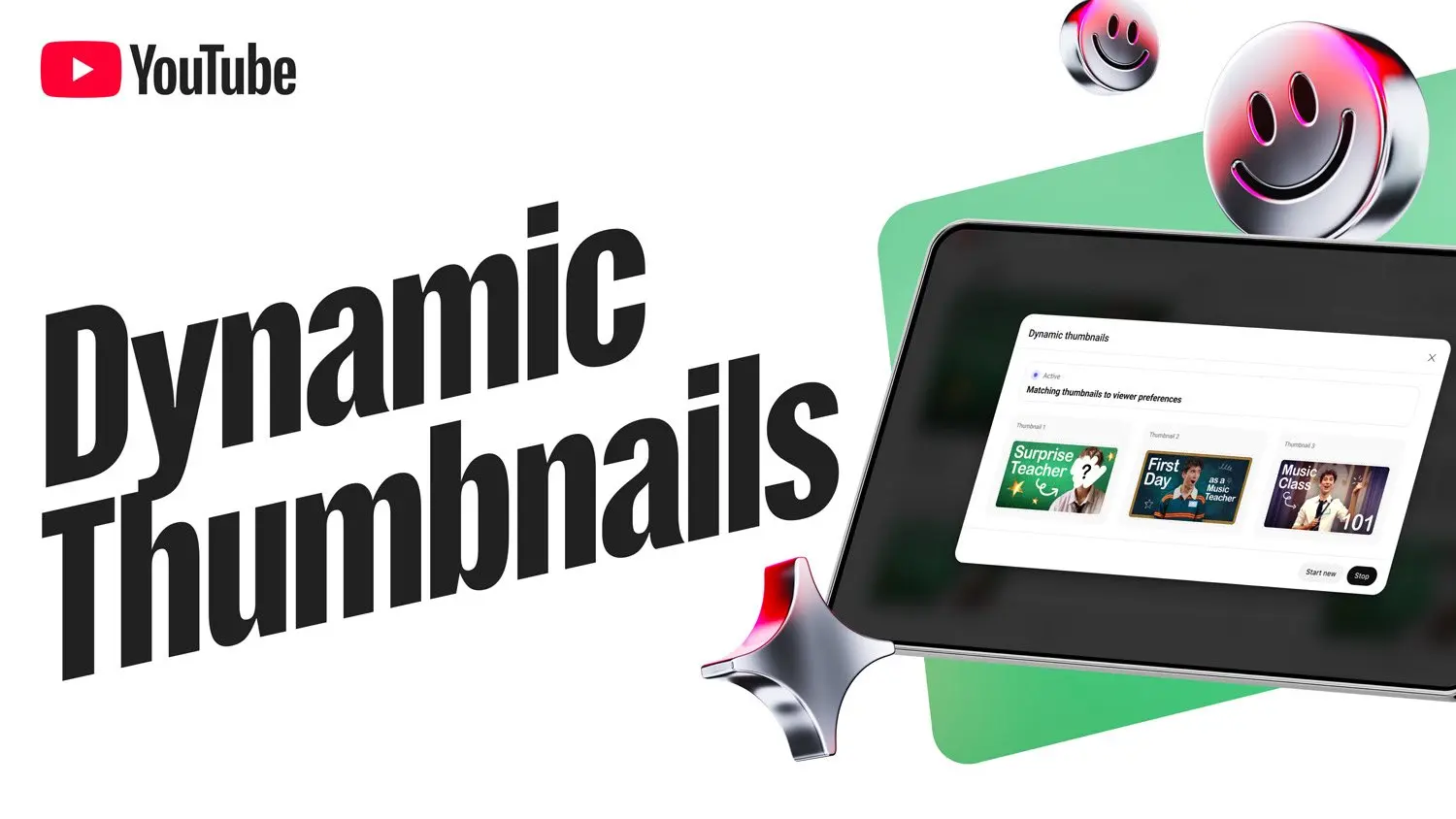
YouTube Dynamic Thumbnails: What Changed & How to Use Them (2026)
YouTube dynamic thumbnails are an announced, AI-powered personalization feature that allows channels to upload three different preview images for a single video, enabling the recommendation algorithm to match the best option to different audience segments permanently. This system continuously optimizes impressions across diverse viewer demographics without eliminating any of the uploaded variants.
What Are YouTube Dynamic Thumbnails?
Revealed as a cornerstone of the platform’s architectural shift toward generative and personalized AI, the introduction of youtube dynamic thumbnails fundamentally changes how visual packaging is distributed to audiences. Historically, creators uploaded a single image intended to appeal to the broadest possible demographic. Under the new paradigm, channels can upload up to three distinct thumbnails for a single video upload. Rather than running a temporary experiment to find one universal winner, the YouTube algorithm evaluates historical viewing habits, behavioral clusters, and demographic data to match the optimal visual variant to each specific viewer segment.
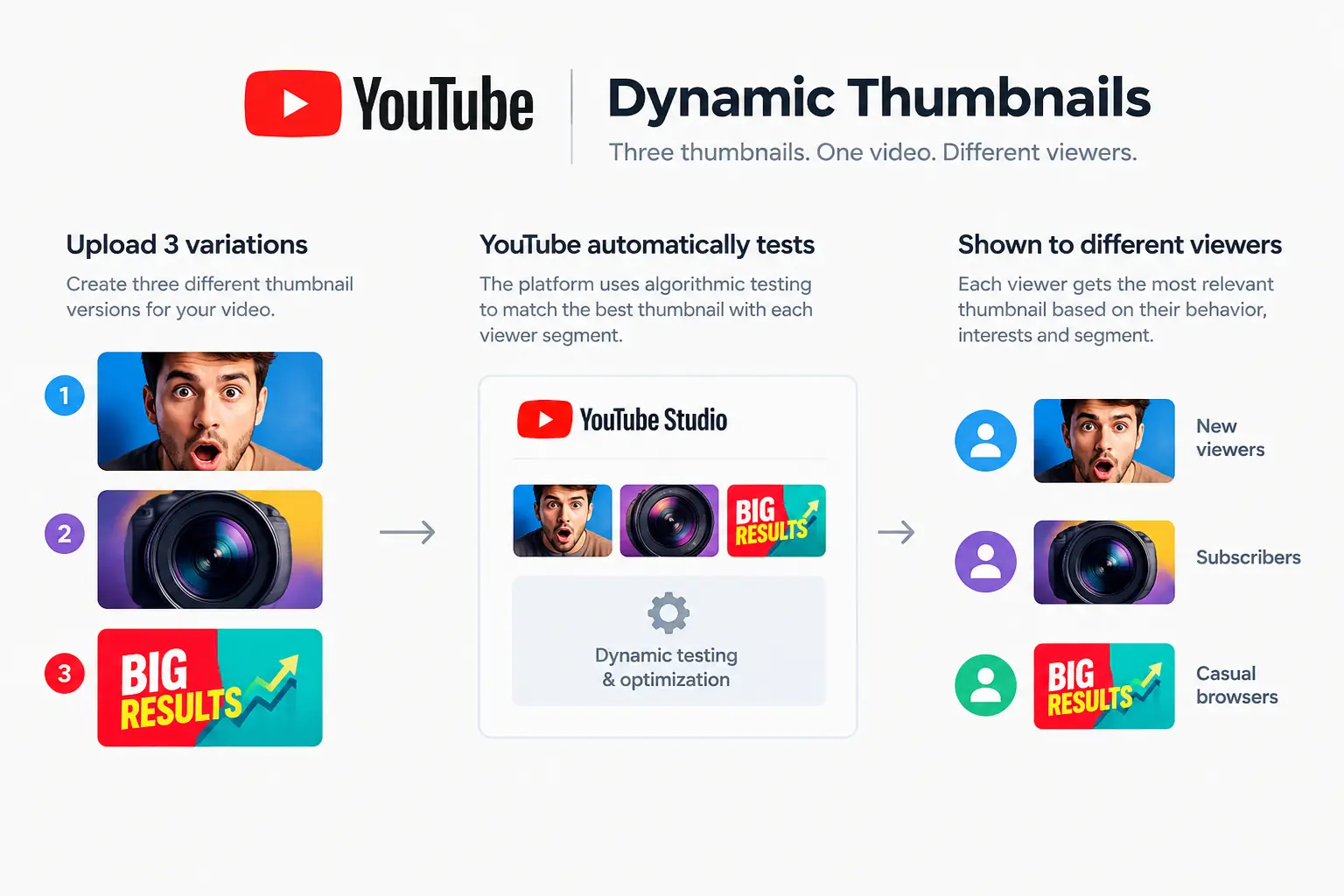
Crucially, this is not a test that concludes with a single victor. All three thumbnail options remain active indefinitely. The system relies on advanced neural networks for candidate generation and ranking, leveraging deep learning to understand user context. According to Aparna Pappu, VP at YouTube, the feature empowers creators to “generate channel-matched thumbnails or use dynamic thumbnails to have YouTube recommend the best of three options to different segments of your audience.” By fragmenting the visual delivery, the youtube thumbnail update 2026 ensures that a long-term subscriber and a first-time searcher receive tailored visual hooks designed to maximize the overall Click-Through Rate (CTR).
Dynamic Thumbnails vs Test & Compare
To understand the strategic value of dynamic thumbnail testing, it is essential to distinguish it from YouTube’s existing Test & Compare feature, which saw its broad official launch in 2024 and has since processed over 40 million title and thumbnail experiments. While both features allow for the upload of three variants, their core mechanics, durations, and end goals serve entirely different functions in a channel’s growth strategy.
| Feature Metric | Test & Compare (A/B Testing) | Dynamic Thumbnails |
|---|---|---|
| Primary Objective | To identify a single, universally effective image for all future viewers. | To continuously match specialized images to specific viewer segments. |
| Algorithmic Mechanism | Rotates variants evenly among the total audience to measure watch time share. | Uses behavioral data to display the optimal variant to each unique viewer. |
| Test Duration | Temporary (runs for up to 14 days or until statistical significance is reached). | Permanent (all three variants remain active and in distribution indefinitely). |
| Final Outcome | One definitive winner is selected; underperforming variants are discarded. | No single winner; the algorithm seamlessly shifts between all three options. |
| Strategic Use Case | Determining general consensus on a completely new visual style or concept. | Maximizing total CTR by appealing to loyal subscribers, new viewers, and casual browsers simultaneously. |
The older Test & Compare system was built to answer a single question: which image yields the highest share of watch time across the total audience? The algorithm temporarily tests the options, ultimately selecting one definitive winner that is subsequently shown to everyone. For the full testing methodology, see our YouTube Thumbnail A/B Testing Guide.
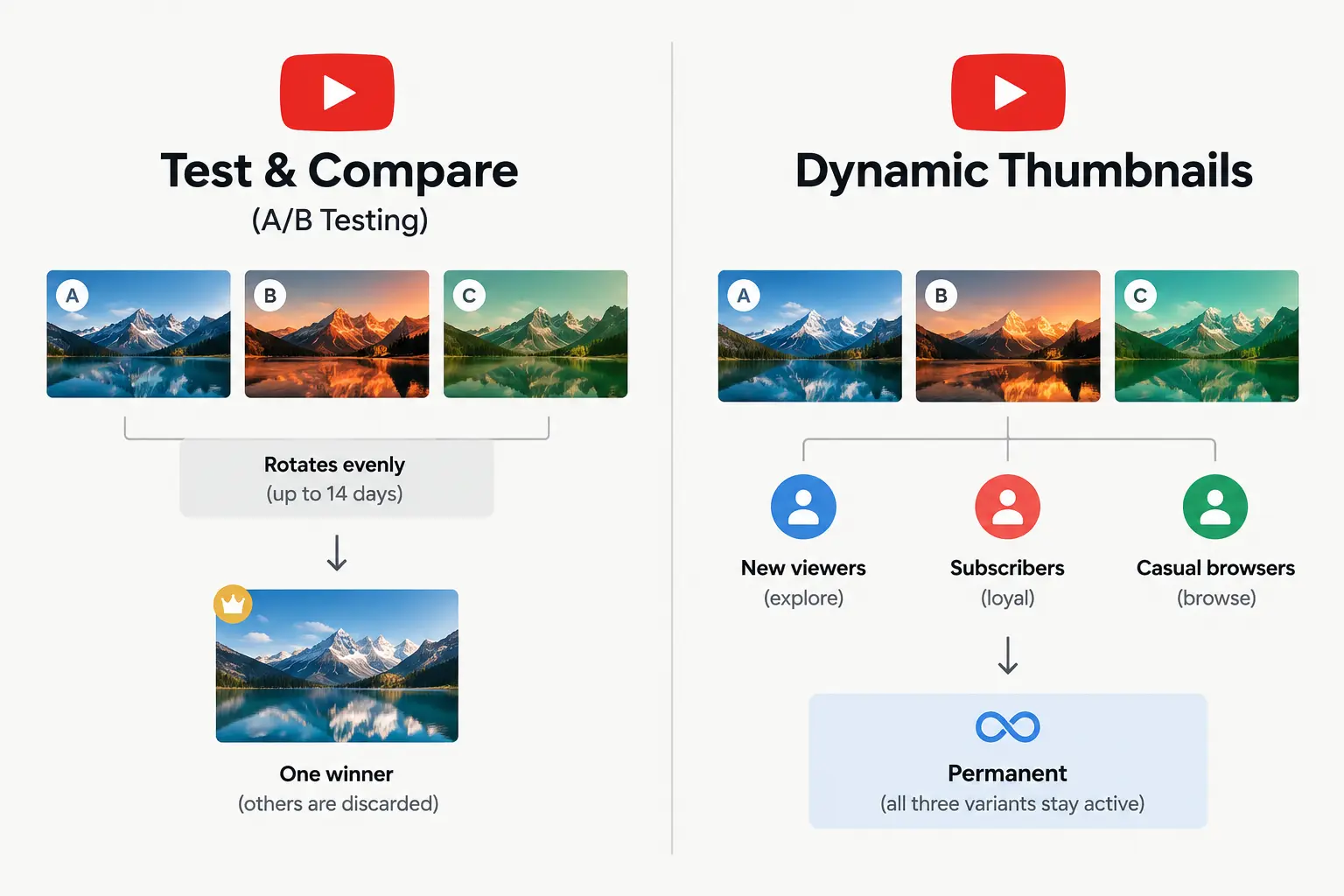
Conversely, the new dynamic system acts as a permanent behavioral matching engine. The platform does not discard the variants that rank second or third in overall popularity, because an image that fails to attract a long-term subscriber might be the exact image that converts a new viewer. It is important to clarify that Test & Compare still exists and remains highly valuable for channels looking to establish a baseline art direction, whereas the dynamic system is utilized to exploit audience fragmentation and maximize reach.
How to Design 3 Thumbnail Variants
The advent of algorithmic audience segmentation requires a fundamental evolution in graphic design strategies. Uploading three images that feature minor, iterative adjustments - such as a slightly different background color or a subtle font change - provides the algorithm with insufficient data to segment the audience effectively. The following practical, psychological framework for variant creation moves beyond generic design advice, ensuring that each uploaded asset serves a distinct acquisition goal. For the complete step-by-step design process with a full checklist matrix, see our dedicated guide on how to design 3 thumbnail variants for dynamic testing.
Variant A: New Viewers (The Curiosity Hook)
This variant is explicitly engineered to capture cold audiences who have never encountered the channel. Because there is no existing brand loyalty or parasocial trust, this design must rely heavily on extreme visual contrast, pattern interrupts, and deep curiosity. Design elements here should prioritize large, expressive faces capturing a real emotional reaction, as human visual processing is biologically wired to halt at strong facial expressions. Text should be eliminated entirely or limited to three highly provocative words. The primary objective is to stop the scrolling behavior of a casual browser through sheer visual disruption.
Variant B: Returning Viewers (The Trust Signal)
The second option targets existing subscribers and frequent viewers who already possess a relationship with the creator. This variant must lean heavily into established channel branding, familiar formatting, and recognizable visual motifs. For this segment, the visual packaging does not need to manufacture artificial hype or rely on extreme shock value. Instead, it should clearly, warmly, and honestly communicate the specific value, topic, or narrative of the video, leveraging the trust already established with the community. Familiarity and consistency are the primary drivers of clicks for this behavioral cluster.
Variant C: Casual/Browse (The Direct Promise)
Designed for the broader homepage feed and high-intent search traffic, the third variant focuses on tangible outcomes, concrete proof, or educational value. It should state a specific payoff in large typography or show the finished result of the video’s premise - such as a highly satisfying “after” shot in a DIY restoration video. This satisfies viewers who are seeking tutorials, product reviews, or specific resolutions, and who make click decisions based on the content’s direct utility rather than the creator’s identity.
By supplying these three vastly different visual concepts, production teams provide the dynamic algorithm with clear, distinct behavioral signals to optimize distribution. To ensure these designs translate seamlessly across devices before they are pushed live, graphic teams must preview each variant to verify that visual hierarchies remain intact on both mobile screens and large television displays.
Video A/B Testing (Also Announced)
While dynamic thumbnail testing segments external visual packaging, the sweeping announcements at Made on YouTube 2026 also introduced tools to test the actual internal content files. Unveiled alongside the thumbnail updates, the video A/B testing feature allows channels to upload up to three different cuts of a single video to determine which version retains viewers the longest.
This feature is primarily engineered to test different opening hooks, varying structural pacing, or entirely different introductory sequences. Starting with YouTube Shorts in early 2027 and subsequently rolling out to long-form content, the system routes the different video files to portions of the audience and monitors retention metrics. Designed to auto-resolve, the algorithm will pick the winning cut after seven days if manual action is not taken by the channel manager. While not directly related to thumbnails, this tool completes the optimization picture by ensuring that the video’s hook perfectly delivers on the promise made by the external packaging.
Ask Studio AI Thumbnails
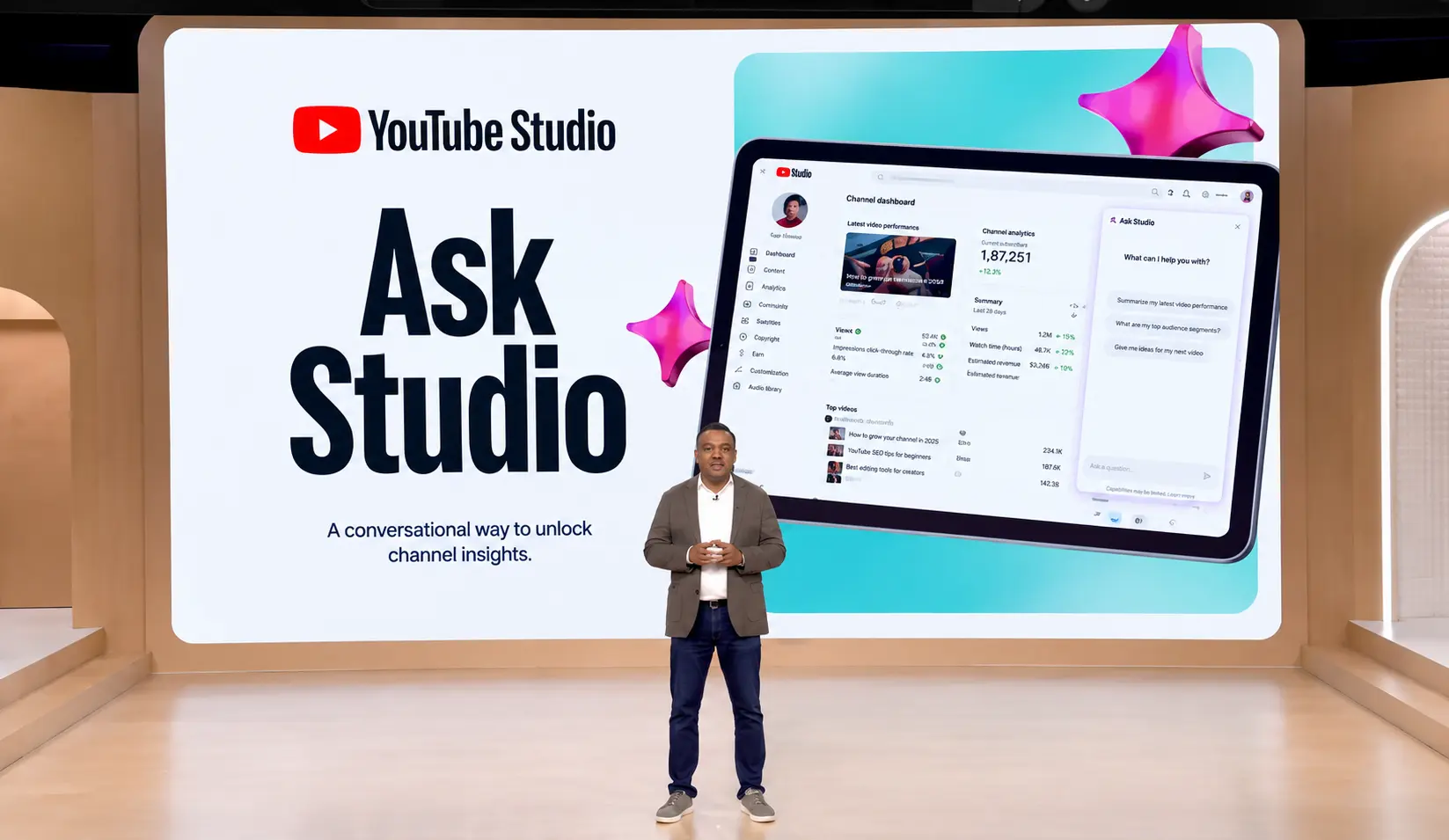
The Ask Studio assistant received a massive architectural upgrade in 2026, transitioning from a reactive analytics chatbot into a proactive, unprompted background agent. Among its most significant new capabilities is generative thumbnail design. Ask Studio can now generate channel-matched thumbnails directly from the context of an uploaded video file, bypassing the need for traditional graphic design software.
Furthermore, this background agent monitors a channel’s historical catalog without requiring a prompt. If it detects that an older video is gaining sudden relevance due to a news event or an unexpected algorithmic spike, it proactively suggests refreshed titles and newly generated thumbnails to help the classic content ride the wave of renewed attention.
However, a critical, honest assessment of this technology reveals its current limitations. While AI generation is excellent for rapid prototyping, creating structural drafts, or testing spatial compositions, it is not yet a replacement for intentional, human-led design. High-converting thumbnails require nuanced emotional intelligence, strategic text placement, and a deep understanding of color psychology that current generative systems cannot reliably replicate. Channels that rely entirely on automated generation risk producing generic, composite imagery that fails to stand out in a highly competitive feed.
What This Means for Creators
The rollout of these advanced creator tools marks the definitive end of the “single perfect thumbnail” era. Content strategy must adapt to treat multi-variant packaging as standard operating procedure. Creators and strategists must stop attempting to force heavy branding, extreme emotional reactions, and detailed textual context into one crowded image. Instead, production pipelines must be updated to distribute these distinct psychological triggers across three specialized, uncluttered assets.
To integrate this workflow efficiently, production pipelines must be rigorously standardized. Because the algorithm will constantly shift between the three options based on user devices ranging from mobile phones to high-definition smart televisions, dimensional accuracy is paramount. Design teams should utilize dedicated formatting tools to resize variants to 1280x720 to guarantee that all variants strictly adhere to YouTube’s exact upload specifications, preventing the accidental cropping of critical text or focal points. After resizing, use our thumbnail compressor to keep each variant under the file size limit.
Frequently Asked Questions
When do Dynamic Thumbnails launch?
The feature was officially unveiled on September 23, 2026, at the Made on YouTube event. According to official announcements, the capability is rolling out to eligible creators soon, with broader expansion and integrations expected to follow the initial testing phases.
Are 3 different thumbnails required?
No, uploading three different thumbnails is not mandatory. However, to fully leverage the audience segmentation capabilities of the algorithm, supplying three distinct conceptual options (such as a curiosity hook, a trust signal, and a concrete promise) is highly recommended to maximize overall impressions and click-through rates.
Does this replace Test & Compare?
No. Test & Compare (A/B testing) remains an active and valuable tool for channels that wish to run a temporary experiment to find a single, universal winner for all viewers. Dynamic thumbnails serve a completely different purpose: permanently displaying different images to different behavioral clusters to maximize reach.
Can this be used on old videos?
Yes. The newly updated Ask Studio AI agent can actively monitor a channel’s back catalog and suggest dynamic thumbnail refreshes for older, evergreen videos, allowing classic content to be repackaged and served to new audiences.
Keep learning:
- How to Design 3 Thumbnail Variants for YouTube Dynamic Testing
- YouTube Thumbnail A/B Testing: Complete Guide
- YouTube Thumbnail Size Guide: All Dimensions for 2026
- High CTR Thumbnails: Design Principles That Work
- MrBeast’s Thumbnail Formula Deconstructed
- Best Thumbnail Design Tools for Creators
- YouTube Thumbnail Color Psychology Guide