The visual packaging of digital video has evolved into a highly quantifiable science. As content platforms become increasingly saturated, the margin for error in visual presentation has virtually disappeared. For content creators seeking to maximize distribution, two distinct optimization methodologies have emerged: the native YouTube Test and Compare feature built into the platform, and independent community-driven voting environments.
Understanding the technical mechanics, inherent limitations, and strategic advantages of each approach is critical for modern content distribution workflows. This guide breaks down both tools so you can use them in the right sequence.
New to thumbnail testing? Start with the complete guide: YouTube Thumbnail A/B Testing: Free Community Voting and Tools 2026
What Is YouTube’s Built-in Test and Compare?
The native YouTube Test and Compare feature represents a significant evolution in platform-level analytics, transitioning from experimental beta testing into a foundational pillar of modern audience development. Initially announced at industry conferences in 2023, the tool underwent a progressive rollout to a small percentage of creators throughout 2024 before achieving wide-scale deployment. By December 2025, the architecture was substantially expanded beyond basic image rotation. The current iteration operates as a unified workflow covering both visual and textual packaging, allowing creators to run concurrent tests on titles alone, thumbnails alone, or combined title and thumbnail packages.
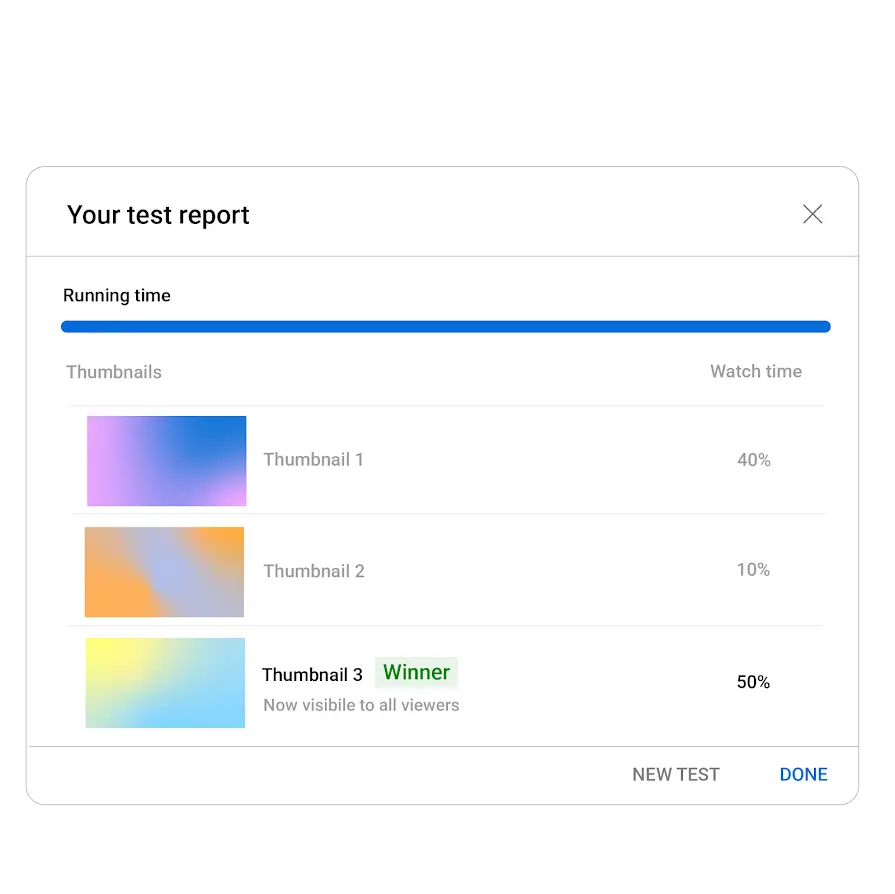
Technically, the native tool functions as a sophisticated concurrent A/B/C testing environment. When a video is submitted for testing, the platform’s recommendation algorithm divides the prospective audience into equal, randomized segments, serving different packaging variations to different viewers simultaneously. The system does not declare a winner based on raw click-through rate. Instead, the algorithmic evaluation relies entirely on “watch time share” - a composite metric measuring which variation generates the most engaged viewing time per impression.
For example, if Thumbnail A receives 1,000 views averaging three minutes, while Thumbnail B receives 800 views averaging five minutes, Thumbnail B wins the experiment despite having fewer initial clicks. This architecture deliberately neutralizes clickbait by punishing variations that successfully earn a click but subsequently gut viewer retention.
Accessing the feature is streamlined within the platform’s proprietary architecture, though it remains confined to specific operating environments. The tool is located exclusively within the desktop version of YouTube Studio. Creators can initiate a test by navigating to the “Content” menu, opening the details of an eligible video, and selecting the “A/B testing” prompt located directly within the Title or Thumbnail interface.
The Limitations of YouTube’s Native Tool
You Must Publish First
The most significant operational vulnerability of native YouTube thumbnail split testing is its strict reliance on live algorithmic traffic. The testing environment is not an isolated sandbox - it utilizes the channel’s actual audience to generate statistical data. Consequently, there is no mechanism for pre-upload validation.
When an unvetted experiment goes live, the creator’s core audience and the broader recommendation algorithm are exposed to variations that may be objectively poor or misaligned with content expectations. Because the algorithm heavily weighs the CTR of a video’s first 24 to 48 hours, testing a weak variant can severely suppress the early momentum required for broader platform distribution. Furthermore, initiating a test the moment a video goes live heavily mixes core subscriber responses with broader audience behavior, often skewing the data away from the target demographic.
Eligibility and Channel Requirements
The native testing infrastructure is heavily gated by stringent platform policies and account standing thresholds. The feature is restricted entirely to creators who have successfully enabled “Advanced Features” through secondary account verification protocols, meaning entirely new or unverified channels cannot access the data.
Strict content format restrictions also apply. The testing functionality is completely disabled for:
- Content marked as “Made for Kids”
- Age-restricted mature content
- Scheduled Premieres (until they transition to standard video format)
- Private uploads
Creators must also maintain technical specifications carefully. If a single variant thumbnail is uploaded at a resolution below 720p, the platform automatically downscales all experiment variants to 480p, heavily compromising the visual integrity of the test.
Long Wait Times for Statistical Significance
Algorithmic confidence requires substantial data density, making the native tool inherently slow. To achieve statistical significance and isolate the variables from external noise - such as day-of-week traffic fluctuations or temporary algorithm surges - the tool demands thousands of impressions.
| Desired Lift to Detect | Impressions Needed (per variant) |
|---|---|
| 5% CTR improvement | ~800 impressions |
| 2% CTR improvement | ~1,900 impressions |
| 0.5% CTR improvement | ~25,500 impressions |
For channels with high traffic volume (exceeding 10,000 impressions daily), a winner can emerge in a few days. For channels with modest traffic, accumulating this volume routinely requires the maximum testing window of two full weeks. This extended timeline renders the tool highly inefficient for time-sensitive, trend-jacking, or news-oriented content where the peak viewership window closes rapidly.
Maximum 3 Variants
The platform imposes a strict architectural limit on creative exploration, capping tests at a maximum of three variations (the control and two challengers). While this limitation ensures that traffic is not diluted across too many options, it forces creators to make highly subjective assumptions before the test even begins.
Top-tier creators frequently generate upwards of fifty variations per video to explore different psychological hooks, facial expressions, and typographical layouts. The strict three-variant limit requires strategists to prematurely discard potentially superior concepts without any empirical data, severely limiting the scope of creative optimization.
How Free Community A/B Testing Works Differently
Community A/B testing fundamentally inverts the traditional optimization timeline by facilitating rigorous pre-publish validation. Instead of utilizing live algorithmic traffic, these external platforms present visual concepts to human panels in a controlled environment.
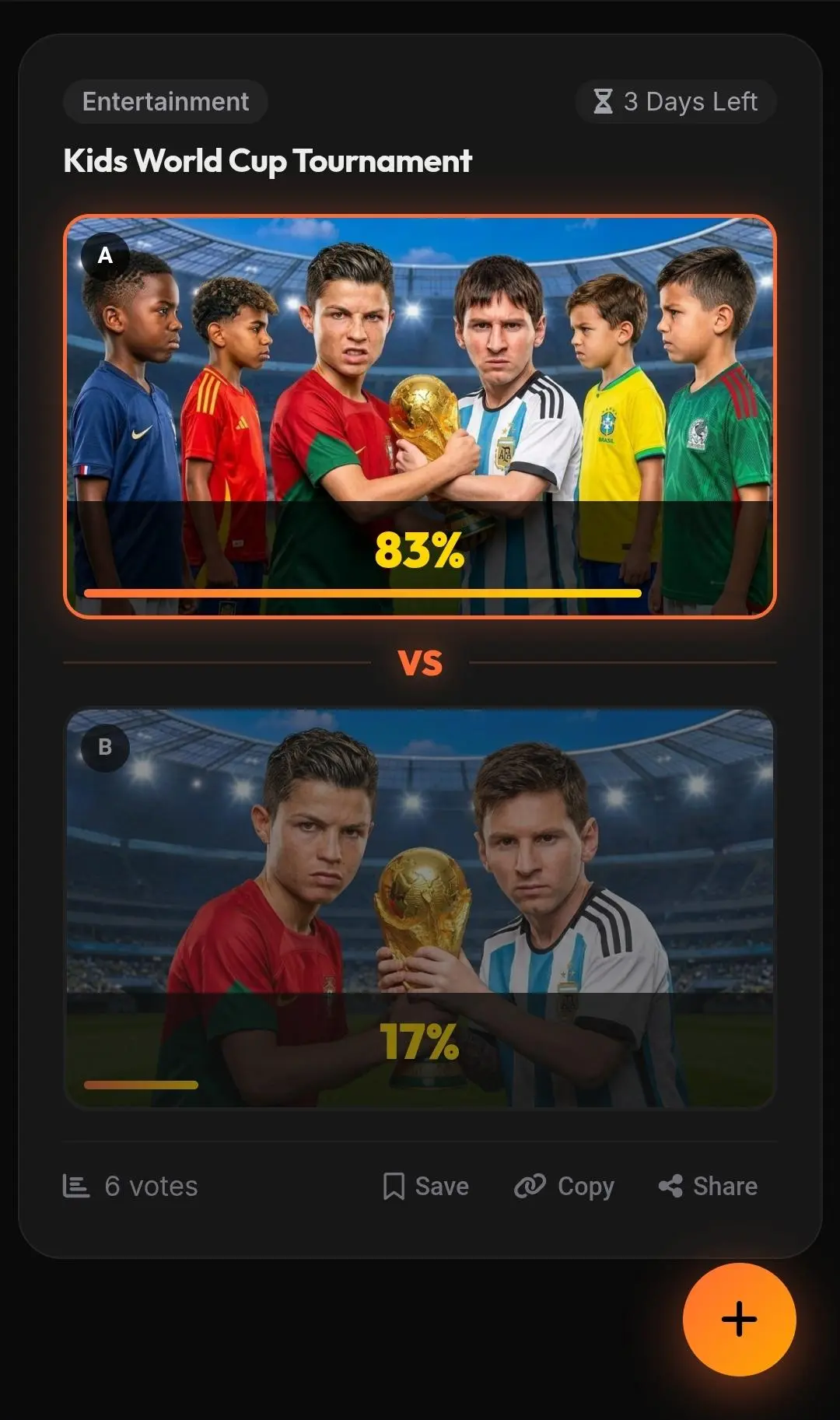
This methodology allows design teams to gauge organic human psychology, evaluate visual clarity at mobile sizes, and measure raw click intent before risking the channel’s core audience response. By identifying elements like proper contrast, optimal facial emotion, and the effectiveness of a curiosity gap beforehand, creators avoid launching videos with fundamentally flawed packaging.
Because this approach relies on direct, active polling rather than passive algorithmic impressions, the velocity of data acquisition is vastly accelerated. Feedback and statistical trends begin to materialize in minutes or hours, rather than the days or weeks required by native platform testing. This rapid turnaround empowers iterative design workflows. A designer can test five distinct conceptual layouts in the morning, identify the strongest direction by lunch, refine the typography in the afternoon, and validate the final polished variations before an evening upload schedule.
Furthermore, external community testing democratizes the optimization process by operating entirely outside of the platform’s proprietary ecosystem. There are no structural gatekeepers or algorithmic thresholds:
- No requirement to unlock Advanced Features
- No minimum subscriber count
- No restriction on video format or content type
- No requirement for an existing audience
This makes it an invaluable resource for smaller channels generating fewer than 1,000 views per video, who physically lack the impression volume to utilize YouTube’s native tool effectively.
Platforms like Touhfa Arena have refined this external methodology through specialized mechanisms designed to extract unbiased human instinct. In standard community feedback environments, such as open forums or comment sections, data is heavily skewed by social proof - subsequent voters are inherently biased by reading previous opinions. The Touhfa Arena infrastructure mitigates this by implementing “blind A/B voting,” forcing users to make a binary visual selection before viewing any community commentary. This ensures every vote accurately reflects a genuine, isolated YouTube impression.
Side-by-Side Comparison
| Feature | YouTube Test and Compare | Free Community Testing (Touhfa Arena) |
|---|---|---|
| Timing in Workflow | Post-publish (requires live video data) | Pre-publish (tests concepts before launch) |
| Testing Speed | Slow (7 to 14 days typical) | Fast (minutes to hours) |
| Variant Limit | Maximum 3 options | Unlimited sequential options |
| Cost | Free (native studio integration) | Free (external platform) |
| Account Requirements | Advanced Features, long-form content only | None (universally accessible) |
| Primary Metric | Watch time share (retention quality) | Human instinct (raw click intent) |
| Reliability Strength | Deep algorithmic alignment | Rapid visual and psychological validation |
| Small Channel Friendly | No (requires significant traffic) | Yes (works with zero existing traffic) |
Which One Should You Use? (The Answer: Both)
The most sophisticated content optimization strategies do not view these tools as mutually exclusive competitors, but rather as sequential phases within a unified, high-performance workflow.
Phase 1 - Pre-Publish Community Testing: When ideating a new upload, design teams should generate a wide array of visual concepts - testing different character framings, color palettes, and typographical treatments without arbitrary limits. Pushing these broad concepts through a blind-voting platform like Touhfa Arena identifies the most resonant psychological triggers and eliminates objectively weak ideas before they can damage a video’s crucial first 24 hours of algorithmic momentum. Use this phase to filter down to your top three candidates.
Phase 2 - Post-Publish Native Testing: Once community consensus has distilled the options down to the absolute strongest contenders, a YouTube thumbnail Test and Compare experiment serves as the ultimate post-publish optimization layer. By uploading the top three pre-vetted variations into the native tool, the algorithm is tasked with measuring the final, most crucial metric: actual traffic behavior. Because the initial designs have already been optimized for raw click intent by community voters, the native tool can safely measure which variation delivers the highest watch time share, ensuring the packaging honestly aligns with the underlying content and drives long-term viewer satisfaction.
Ultimately, the two tools serve entirely different stages of the workflow: community testing defines concept viability with rapid precision, while the native tool utilizes vast datasets to secure long-term algorithmic success.
Frequently Asked Questions
Does YouTube’s Test and Compare work on Shorts?
No. The native testing feature is explicitly restricted to public long-form videos, archived live streams, and podcast episodes. If a video is three minutes or less in duration and utilizes a square or vertical aspect ratio, the platform categorizes it as a Short. This classification immediately revokes access to the testing tool, and any previously active A/B tests for that specific file are terminated.
Can I use both methods on the same video?
Yes, and doing so represents the optimal data-driven workflow. Creators should first use community testing platforms to generate rapid feedback on a high volume of preliminary concepts, isolating the top three performers without risking live traffic. Those three pre-validated, high-performing assets should then be uploaded into the native studio tool upon publication to determine which specific image yields the highest downstream algorithmic viability and viewer retention.
Which gives more reliable results?
Reliability is contingent upon the specific variable being measured. For evaluating raw visual appeal, immediate psychological click intent, and unbiased aesthetic feedback, community platforms utilizing blind voting provide the most reliable human data in a fraction of the time. Conversely, to determine downstream algorithmic success and actual content alignment, the native tool is infinitely more reliable, as it measures watch time share - a metric that ensures high click-through rates do not come at the expense of session time and viewer retention.
Related Guides
- YouTube Thumbnail A/B Testing: Complete 2026 Guide - The full pillar guide covering all methods, tools, CTR benchmarks, and step-by-step walkthroughs
- AI Thumbnail Analyzers vs Real Community Voting - Why AI scores fall short and when human votes give you a stronger CTR signal
- 8 Best YouTube Thumbnail A/B Testing Tools in 2026 - Full comparison of every major tool from free community voting to $75/month enterprise platforms
- Does A/B Testing Really Increase YouTube CTR? - The data behind thumbnail testing and realistic CTR improvement benchmarks by niche